Insulation For Mosques & Large-span Religious Buildings in Pakistan
Mosque projects rarely specify insulation, and when they do, it’s often lifted from a generic commercial building specification that bears little relation to the actual use of the building. Mosques and large span religious buildings, from neighborhood mosques to huge congregational halls with their associated facilities for the Friday and Eid congregations, have distinctly different thermal and acoustic needs based on their often-unusual design and their peculiar patterns of use, both of which are frequently poorly addressed by generic specifications.
Why A Mosque Hall Isn’t An Assembly Hall
An assembly hall or a conference center has a simple, easily-modeled use pattern: roughly similar occupancy throughout the day, with brief periods of maximum occupancy during breaks or lunch hours. A mosque’s main prayer hall has the inverse pattern: it is mostly empty except for brief, intense surges of occupancy during prayer times. This impacts the required insulation characteristics, particularly for cooling, since the load on the air-conditioning system is far greater during those times of near-capacity occupancy than at other times. In a generic commercial building, the insulation would be specified to a daily average; in a mosque, that approach would lead to unacceptable performance during the daily peaks.
The large open volume of a mosque’s main prayer hall, often with no intermediate levels or partitions to break up the space, also has different acoustic characteristics from a generic assembly hall. Similarly, domed roofs and large-span roofing systems have different insulation characteristics than the flat concrete roofs typical of commercial construction.
Dome Roofs, Or What To Do About The Minaret
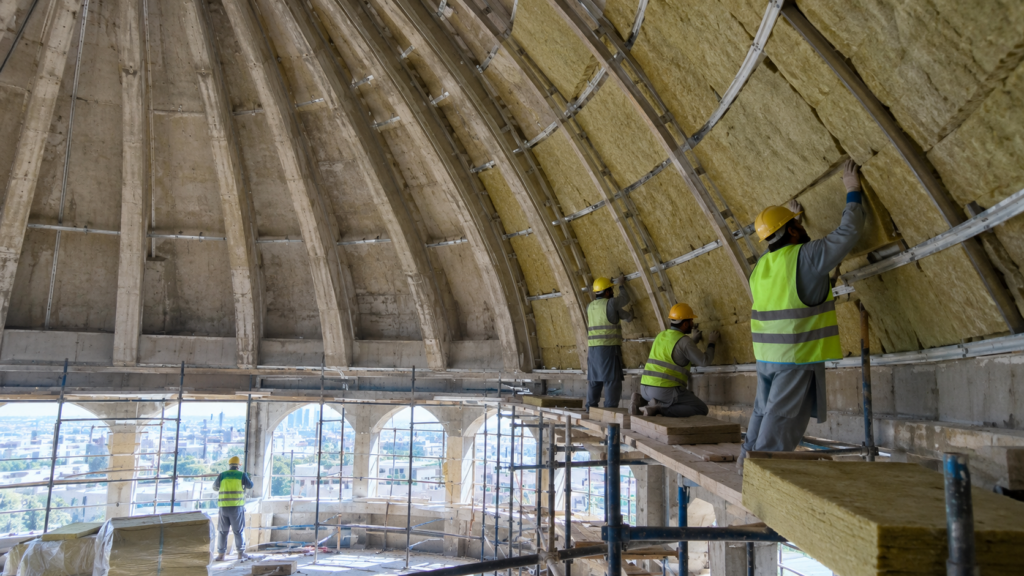
Large mosques often take the form of a dome, which has different insulation characteristics than a flat roof. A dome has a much greater surface area than a flat roof of the same floor area, which means greater heat loss in winter and greater heat gain in summer, all other things being equal. Additionally, domes often have more complex detailing at their base, or more ribs or other features reducing the amount of surface area available for insulation relative to a simple curved roof. Rigid insulation boards are also less effective on curved surfaces, making batt or blanket insulation (such as rockwool) a more attractive option for domes, for both thermal and acoustic reasons.
The combination of curvature and complexity means that a dome requires more careful attention to avoid gaps and interruptions in the insulation layer, particularly at features such as ribs or the base of the dome where a curved roof meets a flat wall. Those details are often ignored on generic specifications for mosques, since contractors often approach a dome as a variation on a flat roof when it should be treated as a curved volume.
Acoustics Are Their Own Thing
Acoustics are critical to a mosque’s functionality, since the imam’s speech needs to be heard clearly by the congregation. That often means that a conventional sound reinforcement system is necessary, but a poorly treated acoustic environment defeats the purpose by swamping the desired sounds with echoes and reverb. Large volumes, particularly under a dome, are notoriously difficult to treat acoustically due to the long reverberation times. Treating the interior surfaces with acoustic insulation wrapped in decorative screens or perforated wood or fabric is often the solution, but that is a far cry from the ubiquitous commercial acoustic tiles used in other building types. Acoustic design is a critical part of a mosque’s insulation specification that is often neglected, particularly the choice of materials.
Thermal Management For Crowds
A mosque’s heating and cooling needs are complicated by the peculiar congregational patterns discussed earlier, which see large swings in occupancy from near-empty to near-full and back again multiple times per day. Cooling is the bigger issue, particularly during the summer months, but heating is also a concern for winter services. In both cases, the thermal load imposed by the congregation far exceeds that of a generic commercial building. Poorly-insulated mosque halls will see temperatures rise sharply when large crowds gather, since bodies generate significant amounts of heat.
A well-insulated roof and wall structure reduce the peak heating and cooling loads, particularly important for a building that sees those peaks only intermittently throughout the day. In northern Pakistan, a well-insulated hall will also hold heat more efficiently during the cold winter months, reducing the fuel costs associated with heating the building during the early morning hours when the Isha or Fajr congregations gather.
Many large mosques and congregational halls are classified as high-occupancy buildings per Pakistan’s National Building Code, requiring fire-rated insulation at key junctions such as compartment walls and in mechanical and electrical rooms. Fire safety is a serious concern for any large building with an appreciable congregation, and fire ratings for insulation are specified for the same reason in other high-occupancy buildings such as cinemas and hospitals. Rockwool’s natural fire resistance makes it a common choice for fire-rated insulation in those applications, and the same benefits extend to mosques.
Minarets And Other Ancillary Structures
Minarets present few insulation challenges beyond standard practices for narrow, tall structures, but enclosed spaces within them such as a muezzin’s chamber may require attention to the same principles as the main prayer hall or adjacent rooms. They are smaller structures within the larger complex, and so their impact on the overall insulation needs of the complex is smaller; their needs should not be overlooked, however, particularly in terms of balancing the insulation of narrow vertical structures with the much larger volumes of the mosque proper.
Thermal and Acoustic Insulation Specification: What Goes Wrong
The most common mistakes in specifying insulation for mosques are applying generic commercial building practices to the unique characteristics of a dome or large open volume, ignoring acoustic considerations in favor of sound system design, and designing around average rather than peak occupancies, particularly during Friday prayers and the Ramadan congregations.
Why It Matters To Pakistan’s Mosque-Building Industry
Mosque-building and renovation is a thriving industry in Pakistan’s urban centers, where local communities invest significantly in their places of worship. For many of these communities, that represents a large outlay of resources that should deliver lasting value; specifying the insulation correctly is critical to ensuring that the mosque building fulfills its design criteria for the life of the structure. Treating the unique characteristics of domes, acoustic environments and occupancy patterns as design specialties rather than applying generic commercial building practices will deliver a mosque that performs as needed during the all-important Friday and Ramadan congregations while still providing value during the rest of the week.
FAQs
Why is insulating a mosque dome different from insulating a flat roof?
A dome’s surface area is much larger than that of a flat roof, and its shape makes it more difficult to achieve good conformity with rigid insulation boards. Flexible insulation such as rockwool batt is often a better choice overall for a dome, including curved wall sections, for both thermal and acoustic reasons.
Why does acoustic treatment matter so much in a mosque?
Large volumes such as mosque halls and domes present significant acoustic challenges that are best mitigated with acoustic insulation, which is applied to surfaces as part of the insulation detail. This requires careful specification, particularly in choosing materials that can be incorporated within the aesthetic details of the mosque without recourse to commercial acoustic tiles.
Does mosque insulation need to account for occupancy swings?
Yes, mosques typically transition rapidly from near-empty to heavily occupied and back to empty several times per day, particularly during the 5 daily prayers. This impacts the building’s heating and cooling needs considerably, and sizing the insulation and mechanical systems to average occupancies may lead to disappointing performance during peak times.
What insulation material is used for fire-rated areas in large mosques?
Fire-rated areas such as compartment walls and ME rooms in large mosques typically use rockwool insulation, the same material used in other high-occupancy buildings such as cinemas and hospitals.
Do minarets need special insulation consideration?
Enclosed spaces within minarets such as muezzin chambers have the same insulation considerations as anywhere else, but the vertical structure of a minaret often presents challenges that are more difficult to address than in a dome or a qibla. They are typically smaller structures within the larger mosque complex, so their insulation needs should be considered as part of the larger design rather than an afterthought.
Contact Pakistan Insulations today for a free consultation and quote.
Phone: +92-21-34529722
Email: [email protected]
Website: www.pakinsulation.com