HVAC Duct & Chilled Water Pipe Insulation in Pakistan: Preventing Condensation and Energy Loss
In Pakistan’s climate, HVAC systems are subject to far greater demands than in most other countries. Temperatures in summer months in Karachi, Lahore and Islamabad routinely exceed 40°C and buildings that rely on mechanical cooling — offices, hospitals, hotels, shopping malls, and industrial facilities — operate their systems continuously to maintain acceptable indoor conditions.
What is less often considered is what happens to the cold produced by those systems before it even reaches the spaces it is meant to cool. Uninsulated or poorly insulated HVAC ductwork and chilled water pipework lose cooling energy to the surrounding environment at every metre of its run. In Pakistan’s hot and humid conditions, the same uninsulated surfaces also attract condensation — moisture that damages ceilings, corrodes pipework, encourages mold growth and creates maintenance problems that compound over time.
This guide covers why HVAC duct and chilled water pipe insulation matters in Pakistan, which materials are appropriate for different applications, and what building owners, mechanical contractors and facility managers need to know before specifying or retrofitting an insulation system.
Why HVAC Duct and Chilled Water Pipe Insulation Matters in Pakistan
The physics are straightforward. A chilled water pipe carrying water at 7°C to 12°C running through a plant room or ceiling void at 35°C to 45°C ambient temperature will absorb heat from its surroundings at a rate determined by the temperature difference and the thermal resistance of whatever is between the pipe surface and the air around it. Without insulation, that thermal resistance is essentially zero — the pipe absorbs heat continuously, the water temperature rises before it reaches the cooling coil, and the chiller has to work harder and longer to compensate.
The same temperature differential that drives heat gain also drives condensation. When a cold pipe surface contacts warm, humid air, moisture condenses on the pipe — exactly as it does on a cold glass on a humid day. In Pakistan’s coastal cities, particularly Karachi, ambient humidity is high enough for much of the year that even moderately cold surfaces will attract condensation without adequate insulation and vapour control.
The consequences of uninsulated or inadequately insulated HVAC systems in Pakistan include:
- Increased chiller energy consumption as systems compensate for cooling losses in distribution pipework and ductwork
- Condensation dripping from pipework onto ceilings, equipment and building fabric below
- Corrosion of pipe and duct surfaces accelerated by persistent moisture contact
- Mold growth on wet insulation surfaces and surrounding building materials — a health and compliance risk in hospitals, food facilities and occupied commercial buildings
- Reduced system efficiency and shortened equipment life
- Increased maintenance costs and unplanned downtime
All of these consequences are avoidable with correctly specified and properly installed insulation.
HVAC Duct Insulation in Pakistan
Supply air ductwork in air-conditioned buildings carries cooled air from the air handling unit to the occupied spaces. Where that ductwork passes through unconditioned spaces — plant rooms, ceiling voids, roof spaces, external risers — it is exposed to ambient temperatures significantly higher than the air inside it. Without insulation, the duct gains heat along its run, delivering warmer air to the space than the system was designed for and forcing the air handling unit to work harder to compensate.
Glass Wool Duct Wrap and Duct Boards
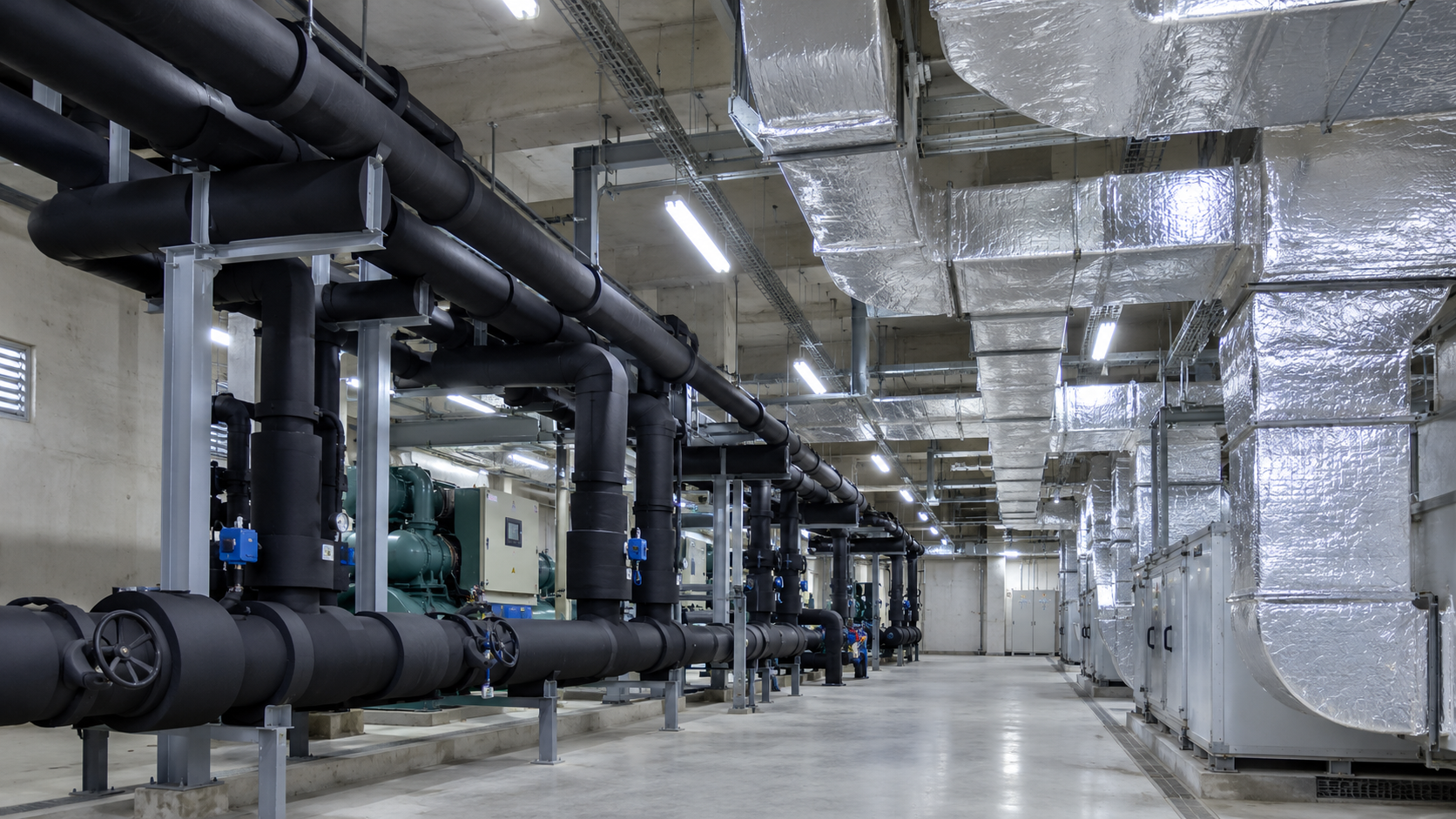
Glass wool is the most widely used insulation material for HVAC ductwork in Pakistan. Available as flexible blanket wrap with a factory-applied aluminium foil facing, or as rigid duct boards for internal lining applications, glass wool provides effective thermal insulation at a competitive cost across the temperature ranges typical of supply air systems.
For external duct wrap applications, glass wool blanket with an aluminium foil facing is wrapped around the outside of the duct and secured with adhesive and mechanical fasteners. The foil facing serves as a combined vapour barrier and surface finish, reflecting radiant heat and preventing moisture ingress into the insulation.
Pakistan Insulations (Pvt.) Ltd., established in 1986, manufactures glass wool insulation products and has supplied duct insulation to commercial, industrial and infrastructure projects across Pakistan for nearly four decades.
Key considerations for duct insulation specification:
- Thickness: For supply air ducts in Pakistan’s climate, a minimum of 25mm glass wool wrap is typical for internal ceiling void applications. Ducts running through hot roof spaces or external locations may require 38mm to 50mm to achieve adequate thermal performance.
- Facing: Aluminium foil facing is standard for duct wrap in Pakistan and serves as both vapour barrier and surface protection. All seams and joints in the facing must be sealed with aluminium foil tape to maintain vapour barrier continuity.
- Joints and penetrations: Breaks in the insulation at duct joints, hangers and penetrations are the most common source of thermal bridging and condensation in duct systems. These must be carefully detailed and sealed.
Rockwool for Fire-Rated Duct Applications
Where ductwork passes through fire-rated walls, floors or ceilings, fire-rated insulation is required to maintain the integrity of the fire compartment. Rockwool duct wrap and boards provide the non-combustibility required for fire-rated duct applications — a specification requirement in hospitals, hotels, shopping malls and other high-occupancy buildings in Pakistan.
Pakistan Insulations manufactures Rockwool under the Termolan brand and can supply fire-rated duct insulation products for applications where fire compliance is a requirement.
Chilled Water Pipe Insulation in Pakistan
Chilled water pipework is the most condensation-critical insulation application in Pakistan’s HVAC systems. Pipes carrying water at 7°C to 12°C in ambient conditions of 35°C to 45°C with high relative humidity present a severe condensation risk that standard thermal insulation alone cannot fully address without an effective vapour barrier.
Understanding the Vapour Barrier Requirement
For chilled water pipe insulation, the vapour barrier is as important as the thermal insulation itself. The purpose of the vapour barrier is to prevent warm, humid ambient air from reaching the cold pipe surface — because if humid air reaches the cold surface, condensation will occur regardless of the thermal insulation surrounding it.
A vapour barrier that is breached — at joints, seams, pipe supports, valves or any penetration — will allow moisture to migrate through the insulation and condense on the pipe surface. In Pakistan’s humid climate, even small breaches in the vapour barrier can result in significant condensation accumulation inside the insulation, leading to wet insulation, reduced thermal performance and corrosion of the pipe surface beneath.
The vapour barrier must be:
- Continuous — with no gaps, breaks or unsealed seams anywhere along the pipe run
- Correctly positioned on the warm side of the insulation — never between the insulation layers
- Properly detailed at all pipe supports, hangers, valves, flanges and penetrations
- Compatible with the insulation material and the pipe operating temperature
Closed Cell Elastomeric Foam Insulation
Closed cell elastomeric foam — commonly known by brand names such as Armaflex — is the preferred insulation material for chilled water pipework in Pakistan. Its closed cell structure provides inherent vapour resistance without a separate vapour barrier for smaller pipe diameters, making it highly suitable for the condensation-critical conditions of chilled water applications.
Elastomeric foam is available as pre-formed pipe sections for standard pipe diameters and as sheet material for larger pipes, flat surfaces and irregular shapes. It is flexible, easy to install and provides a smooth, cleanable surface finish.
For chilled water pipe insulation in Pakistan, thickness selection should account for:
- Pipe operating temperature
- Ambient temperature and relative humidity in the installation location
- Pipe diameter
- Whether the installation is in an air-conditioned or unconditioned space
In Pakistan’s hot and humid conditions, particularly in Karachi, thicker insulation is generally required compared to temperate climates to achieve condensation-free performance. Under-specified insulation thickness is one of the most common causes of condensation problems on chilled water pipework in Pakistani buildings.
Glass Wool and Rockwool Pipe Sections with Vapour Barrier
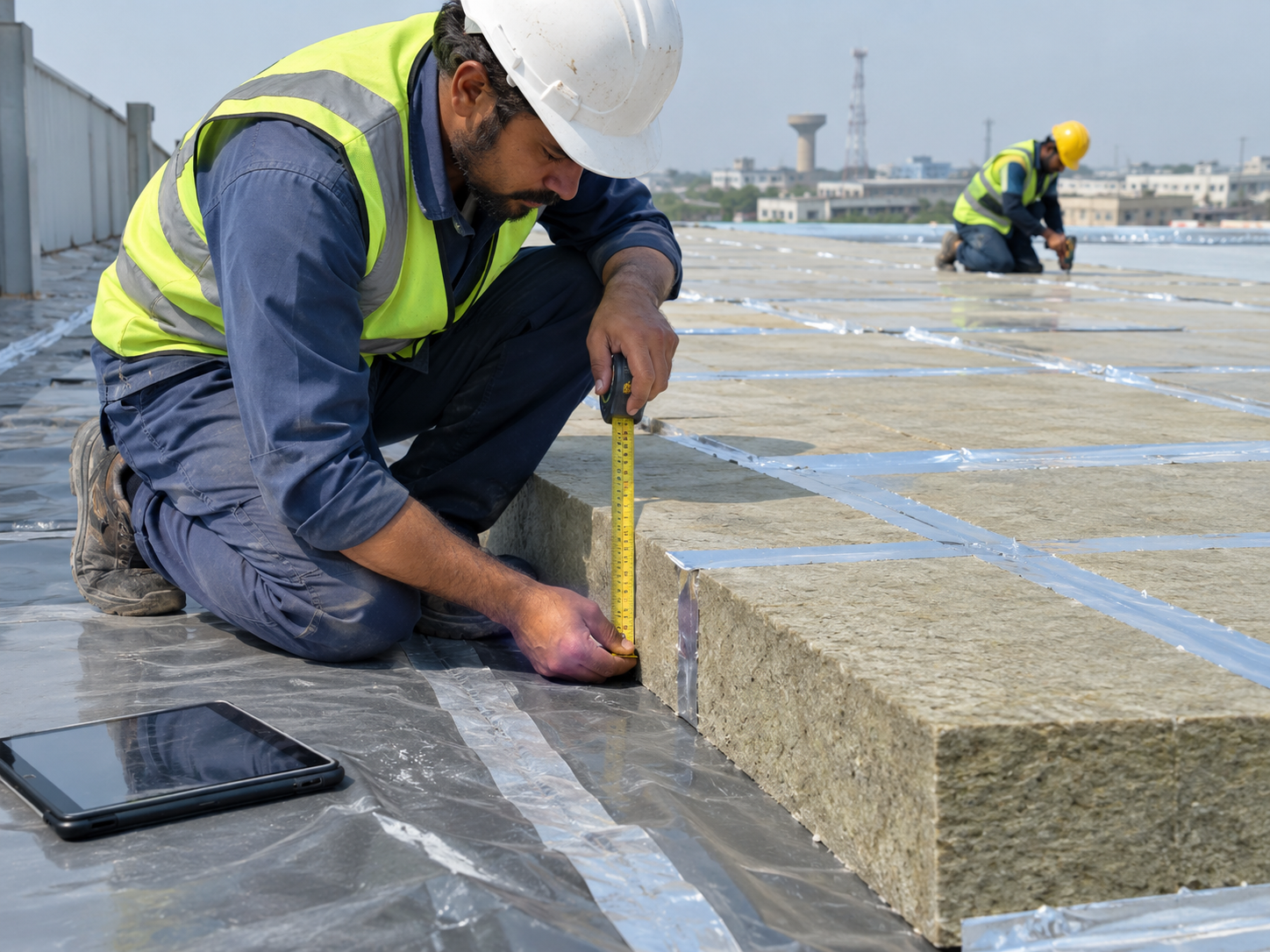
For larger diameter chilled water pipes and for applications where fire resistance is a requirement, pre-formed glass wool or Rockwool pipe sections with a factory-applied aluminium foil vapour barrier are used. Pakistan Insulations manufactures Rockwool pipe sections and supplies glass wool pipe insulation for industrial and commercial HVAC applications across Pakistan.
For chilled water applications using mineral wool pipe sections, the vapour barrier integrity is critical. All longitudinal seams and circumferential joints must be sealed with self-adhesive aluminium foil tape, and all pipe supports must be thermally broken to prevent cold bridging through the support into the ambient environment.
Common Installation Mistakes in Pakistan’s HVAC Insulation Projects
The majority of condensation and energy loss problems in Pakistani HVAC systems are not caused by wrong material selection — they are caused by installation errors that compromise otherwise adequate specifications. The most common mistakes are:
- Unsealed joints and seams. Every joint in duct wrap or pipe insulation that is not fully sealed with foil tape or sealant is a path for moisture ingress. In Pakistan’s humid climate, even small gaps will result in condensation inside the insulation assembly.
- Insulation compressed at pipe supports. When insulation is compressed at pipe hangers and supports, its thermal resistance is reduced at exactly the points where cold bridging is most likely. Pipe supports on chilled water lines should be thermally broken using insulating inserts.
- Valves and flanges left uninsulated. Valves, flanges and fittings are frequently left uninsulated because they are assumed to be too complex to insulate or because removable jacketing is not specified. An uninsulated valve on a chilled water line can drip condensation continuously throughout the cooling season.
- Insufficient thickness for ambient conditions. Insulation thickness that would be adequate in a temperate climate may be insufficient to prevent condensation in Pakistan’s summer conditions. Thickness selection must account for local ambient temperature and humidity, not just pipe operating temperature.
- Vapour barrier on the wrong side. Installing a vapour barrier between two layers of insulation, rather than on the outermost warm surface, traps moisture inside the assembly and worsens the condensation problem it was meant to solve.
Specifying HVAC Insulation for Pakistani Projects
When specifying duct and chilled water pipe insulation for a project in Pakistan, the following should be established before selecting material and thickness:
- Operating temperature: Supply air temperature for ductwork; chilled water flow and return temperatures for pipework.
- Ambient conditions: The temperature and relative humidity of the space in which the insulated service will run. Plant rooms, roof spaces and external locations have significantly different ambient conditions from air-conditioned ceiling voids.
- Fire requirements: Whether the ductwork or pipework passes through fire-rated construction, and what fire rating is required for the insulation.
- Access requirements: Valves and flanges that require regular access for maintenance should be specified with removable insulating jackets rather than fixed insulation.
- Installation environment: Coastal locations such as Karachi require more conservative vapour barrier specifications than inland locations due to higher ambient humidity throughout the year.
Long-Term Benefits of Correct HVAC Insulation
The investment in correctly specified and properly installed HVAC duct and pipe insulation delivers measurable benefits across the operating life of the building:
- Lower chiller energy consumption. Reducing heat gain into chilled water pipework and supply air ductwork directly reduces the load on the chiller and air handling units, cutting electricity consumption.
- Elimination of condensation damage. Properly insulated and vapour-sealed pipework and ductwork eliminates the dripping condensation that causes ceiling damage, corrosion and mold growth in Pakistani buildings.
- Extended equipment life. Systems operating at design conditions rather than compensating for distribution losses experience lower wear and longer service intervals.
- Reduced maintenance costs. The remedial costs associated with condensation damage — repainting, replacing corroded pipework, treating mold — are avoided entirely with correctly installed insulation.
Frequently Asked Questions
Why does condensation form on chilled water pipes in Pakistan?
Condensation forms when a cold pipe surface contacts warm, humid air. In Pakistan’s climate — particularly in coastal cities like Karachi — ambient air is warm and humid enough for much of the year that any cold pipe surface without adequate insulation and vapour barrier will attract condensation. The solution is insulation thick enough to keep the outer surface of the insulation above the dew point of the surrounding air, combined with a continuous vapour barrier to prevent humid air from reaching the cold pipe surface.
What is the best insulation for chilled water pipes in Pakistan?
Closed cell elastomeric foam is the preferred material for chilled water pipe insulation in Pakistan due to its inherent vapour resistance and ease of installation. For larger diameter pipes and fire-rated applications, pre-formed Rockwool or glass wool pipe sections with a factory-applied aluminium foil vapour barrier are used. Thickness must be selected based on local ambient conditions, not just pipe operating temperature.
What insulation is used for HVAC ducts in Pakistan?
Glass wool blanket wrap with an aluminium foil facing is the most widely used duct insulation in Pakistan for supply air ductwork. Rockwool products are specified where fire-rated duct insulation is required. All joints and seams in duct insulation must be sealed with aluminium foil tape to maintain the vapour barrier and prevent heat gain.
How thick should chilled water pipe insulation be in Pakistan?
Insulation thickness for chilled water pipework must be calculated based on pipe operating temperature, ambient temperature, ambient relative humidity, and pipe diameter. Thickness that would be adequate in a temperate climate is often insufficient in Pakistan’s hot and humid summer conditions. A qualified insulation engineer can calculate the correct thickness for specific project conditions to ensure condensation-free performance.
Who supplies HVAC duct and pipe insulation in Pakistan?
Pakistan Insulations (Pvt.) Ltd. manufactures Rockwool pipe sections and glass wool products and has supplied HVAC insulation to commercial, industrial and infrastructure projects across Pakistan since 1986. The company provides both material supply and installation services for duct and pipe insulation projects.
Contact Pakistan Insulations
If your building is experiencing condensation on chilled water pipework, energy losses in HVAC distribution, or you are specifying insulation for a new mechanical services installation, contact Pakistan Insulations for a project-specific recommendation.
📞 +92-21-34529722
✉ [email protected]
🌐 www.pakinsulation.com