Residential Insulation for New Housing Societies in Pakistan (DHA, Bahria Town & Beyond)
Every conversation I have with a homeowner building within a new gated housing society begins with the layout, marble, the kitchen fittings, and whatever insulation they managed to squeeze in as a tacked-on bonus for whatever else the contractor was already planning to do. It’s backward. A beautifully-finished house with an uninsulated roof will reliably remain miserably hot every summer afternoon, regardless of the tilework.
Why Housing Society Construction Has a Consistent Consistency Gap
Pakistan’s biggest planned housing societies — DHA developments across all its relevant cities, Bahria Town’s multi-phased developments, and all the smaller gated communities that followed their lead — share a pretty standard construction pattern: reinforced concrete frame with brick or block infill walls and flat RCC roofs. Quick to build, familiar to every contractor in the country, but never intended to have thermal performance beyond what the standard contractor scope might have allowed, unless the homeowner specifically asked for it and had the budget to justify it.
And so we see a massive number of brand-new homes, some of them fairly expensive by any measure, performing thermally roughly equivalent to a home built decades ago. Beautifully-finished, but also miserably hot every summer afternoon when the AC bill comes due.
Where the Heat Comes From
In a standard two- or three-story house on a flat RCC roof, the top floor takes it worst of all, because concrete is a very efficient heat absorber that continues radiating it out downward well into the evening. Top-floor bedrooms in these kinds of houses tend to be the hottest rooms in the house, running the air-con longest and hardest of any.
West-facing walls are a close second, particularly in the case of corner plots or a particular layout making a bedroom or living area on the west side without much shade.
Roof Insulation: The Best ROI for Budget-Conscious Homeowners
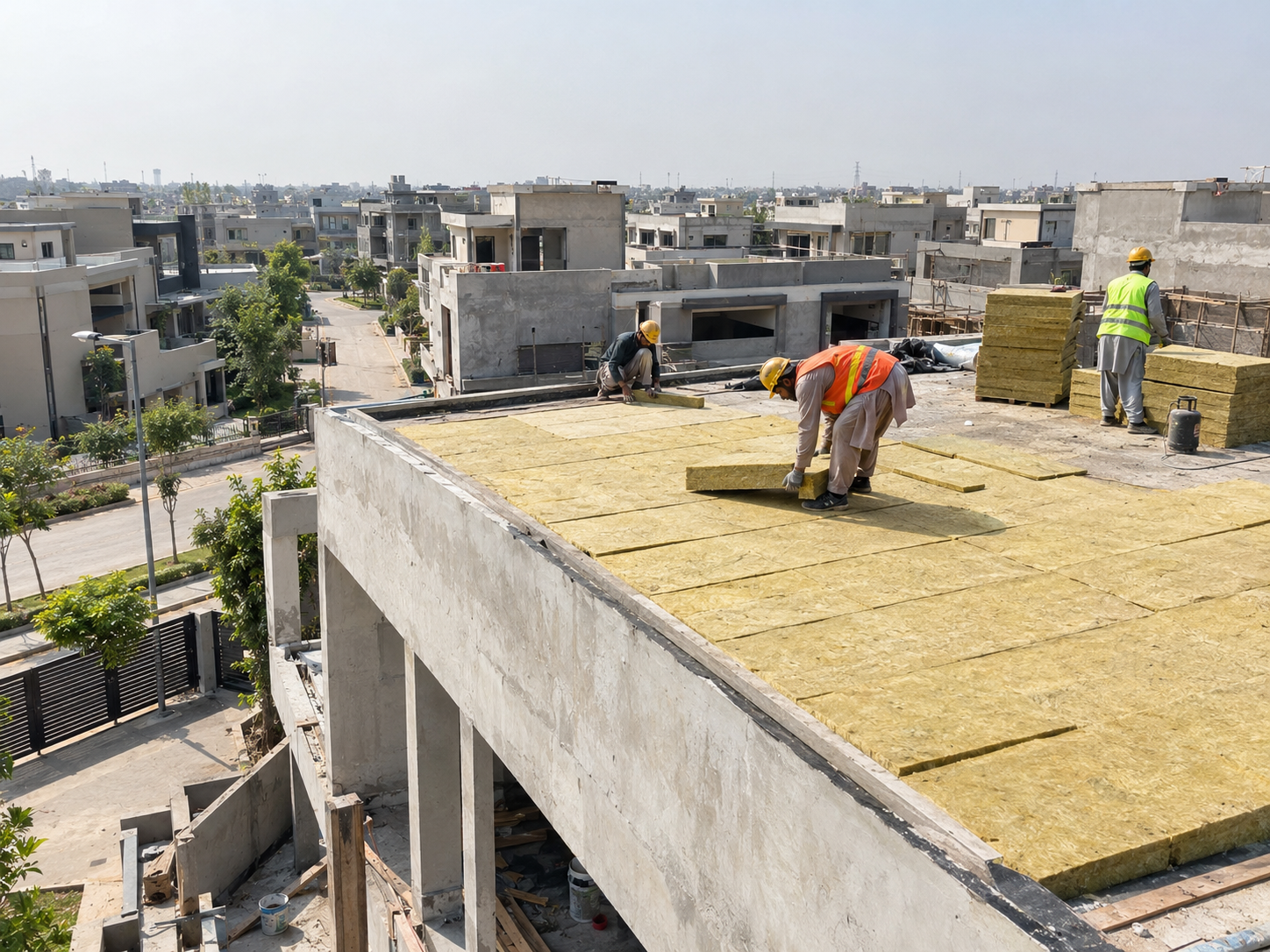
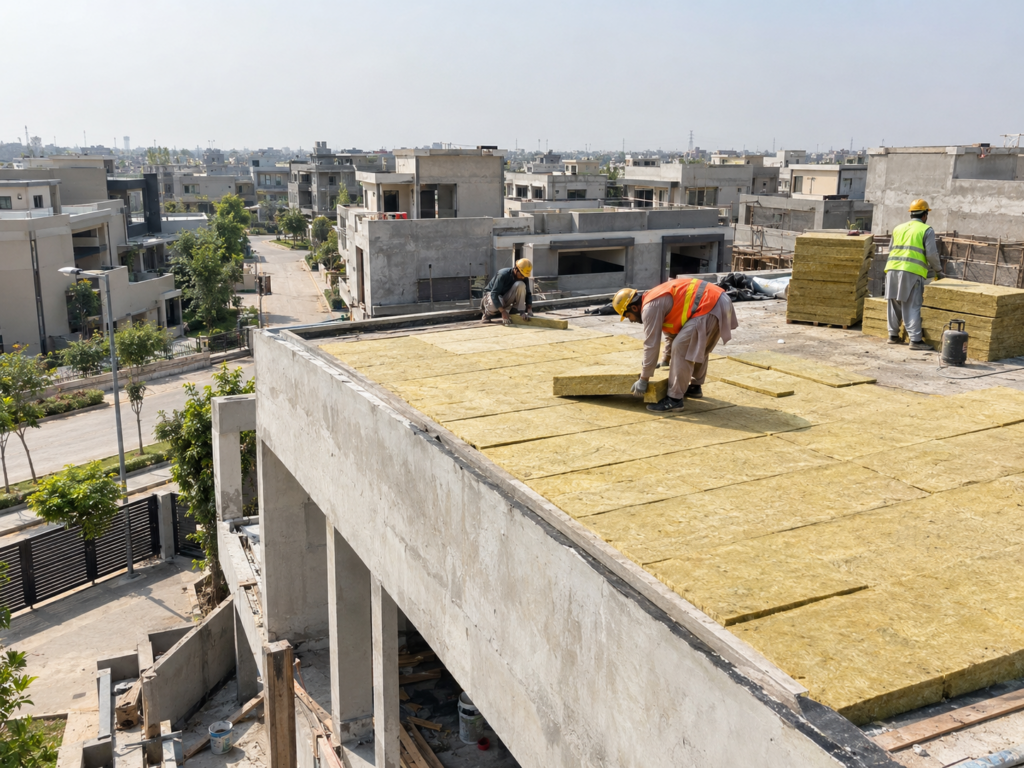
For budget-conscious homeowners within a housing society, roof insulation is the easiest place to get big comfort gains for comparatively little cost (relative to the size of the overall home project). A layer of rigid insulation board or rockwool beneath the waterproofing membrane or as part of a built-up roof assembly goes a long way in cutting the amount of heat radiating down into top-floor rooms, and is one of the easiest retrofits to specify, even if a house is already largely built, since it doesn’t require disturbing interior wall finishes.
Especially worth considering in houses with a rooftop that serves as a usable space — a rooftop room, laundry area, or servant quarters that many houses in these societies tend to include as standard. These kinds of spaces are right below the hottest part of the roof and will see disproportionate benefit from proper insulation.
Wall Insulation: Worth Considering at Design Stage
Wall insulation is more difficult and expensive to retrofit after the fact, since it often involves either building in a cavity walling system from the start or retrofitting an external insulation and cladding system after the fact. For homeowners at design stage, a cavity wall with rockwool or glass wool filling, or at minimum increased thickness with an insulating block, is significantly more cost-effective than retrofitting a solid wall after the fact.
West- and south-facing walls in particular are worth considering for a cavity wall solution at design stage, as they take the brunt of direct solar radiation.
Acoustic Comfort Matters More Than Most Homeowners Expect
Many of these housing societies are fairly close together in terms of house spacing, leading to shared party walls between semi-detached houses or row houses transmitting far more sound than most homeowners would expect going into their purchase. Rockwool’s acoustic properties make it a good addition to party walls (particularly between houses) and walls between bedrooms and noisier common areas within the same house, addressing a comfort issue that has nothing to do with temperature, but is just as impactful.
Rockwool vs. Glass Wool for Residential Use
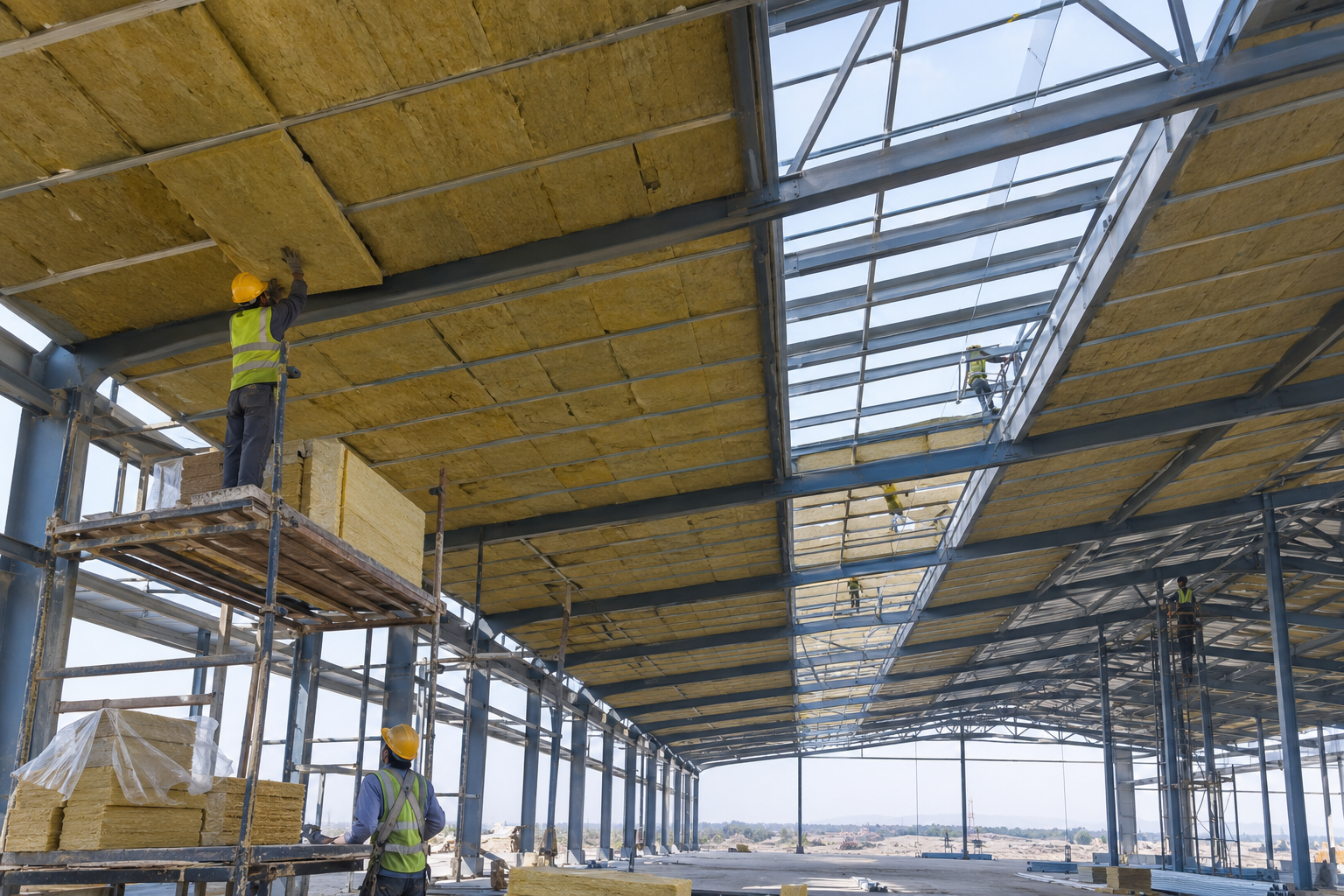
For most residential applications in these kinds of housing societies, glass wool is the more budget-friendly option and performs fine thermally for typical cavity walls and pitched roof spaces where houses have them. Rockwool becomes more desirable in situations where fire resistance or acoustic performance are priorities — shared party walls, houses with attached garages or generator rooms, or the homeowner specifically wants the additional fire-safety edge rockwool provides over glass wool.
Budgeting In Insulation Into a Home Build
The number 1 reason homeowners avoid insulation is that it’s seen as a competing luxury upgrade against other visible finishes, rather than a necessary component of the structural and envelope budget. Roof insulation in particular is a relatively small investment on the scale of a typical house in these kinds of societies, particularly over the lifetime of the building and the multi-year savings on air-con costs it provides, compared to the cost difference between a typical roof insulation product and one with superior thermal performance.
The right approach is to budget for insulation as part of the structural and envelope budget, alongside the roof and wall specification, rather than as an optional finishing upgrade decided at the point when the project budget is already stretched very thin.
The Most Common Mistakes
The most common mistakes are leaving the insulation decision to the contractor (who is unlikely to budget it in if they aren’t specifically asked to) and seeing it strictly as a summer cooling measure rather than a year-round comfort solution, and retrofitting it as an afterthought when the cooling bills arrive later on, which is always far more expensive and less effective than specifying it correctly from the start.
Why This Matters as Pakistan’s Housing Societies Continue to Grow
These kinds of societies continue to expand in a variety of relevant cities (Lahore, Karachi, Islamabad) and the expansion rate shows no sign of slowing. As electricity tariffs continue to rise, the gap in comfort and cost between an insulated and uninsulated home will only become more apparent to homeowners in these societies over time. Getting insulation right at the design and construction stage is dramatically cheaper and more effective than retrofitting it later on.
FAQs
Do homes in Pakistani housing societies come with insulation by default?
No, not really. Most of these societies have insulation as an additional request to the contractor that the homeowner needs to specifically budget for.
Which part of a house benefits most from insulation in Pakistan’s climate?
Roof insulation will provide the most noticeable comfort gains in this climate, since flat RCC roofs absorb and radiate significant heat into top-floor rooms throughout the day and evening.
Should I use rockwool or glass wool for my house?
Glass wool is sufficient for most residential applications and is more budget-friendly. Rockwool is worth the extra cost in wall cavities where fire resistance or between party walls is a priority.
Is it cheaper to add insulation during construction or after the house is built?
During construction by a significant margin, especially for wall insulation, which usually requires disturbing finished wall finishes if added later. Roof insulation is somewhat easier to retrofit, but still costs more after the fact.
Does insulation help reduce noise between houses in a housing society?
Yes. Rockwool in particular has strong acoustic properties and is worth the investment to add to shared party walls between semi-detached or row houses, where sound transmission tends to be more noticeable than most homeowners expect.
Contact Pakistan Insulations today for a free consultation and quote.
Phone: +92-21-34529722
Email: [email protected]
Website: www.pakinsulation.com