Seismic Zones and Insulation: What Pakistan’s Earthquake Risk Means For Wall Assemblies
Insulation specifications rarely if ever consider seismic design, and structural engineers rarely if ever think about insulation, meaning discussion between the two is limited to resolving problems. Nowhere is that less useful than in Pakistan’s earthquake fault zones, which cover parts of Khyber Pakhtunkhwa, Azad Jammu and Kashmir, and northern Punjab.
Insulation is inert when it comes to seismic events, as the job of withstanding forces during and after an earthquake belongs to the structural frame. However, how the insulation and its supporting elements are detailed within a wall assembly may well determine if they hold together when the building does, or turn into dangerous projectiles, compromised fire protection, or hidden pockets of under-performance.
Why Seismic Design And Insulation Detailing Are Intersecting
Buildings in seismic zones have to be built to move, meaning their structural and non-structural components, including non-structural walls, have to be able to withstand the forces imposed on them by movement. This, in turn, usually results in a building having ductile structural detailing and movement joints designed to withstand the movement imposed on them during an earthquake, with connections between structural and non-structural walls and elements also designed in a similar fashion. In other words, a rigid frame that is unyielding is likely to do worse in shaking ground than a frame designed to move with it, and insulation and its supporting elements, being part of the non-structural building elements, can be expected to encounter similar issues if not detailed alongside them.
This can make detailing insulation and its continuous vapor retarder, especially at junctions with other building elements, particularly important to address in seismic zones.
Rigid Board vs Flexible Batt Insulation
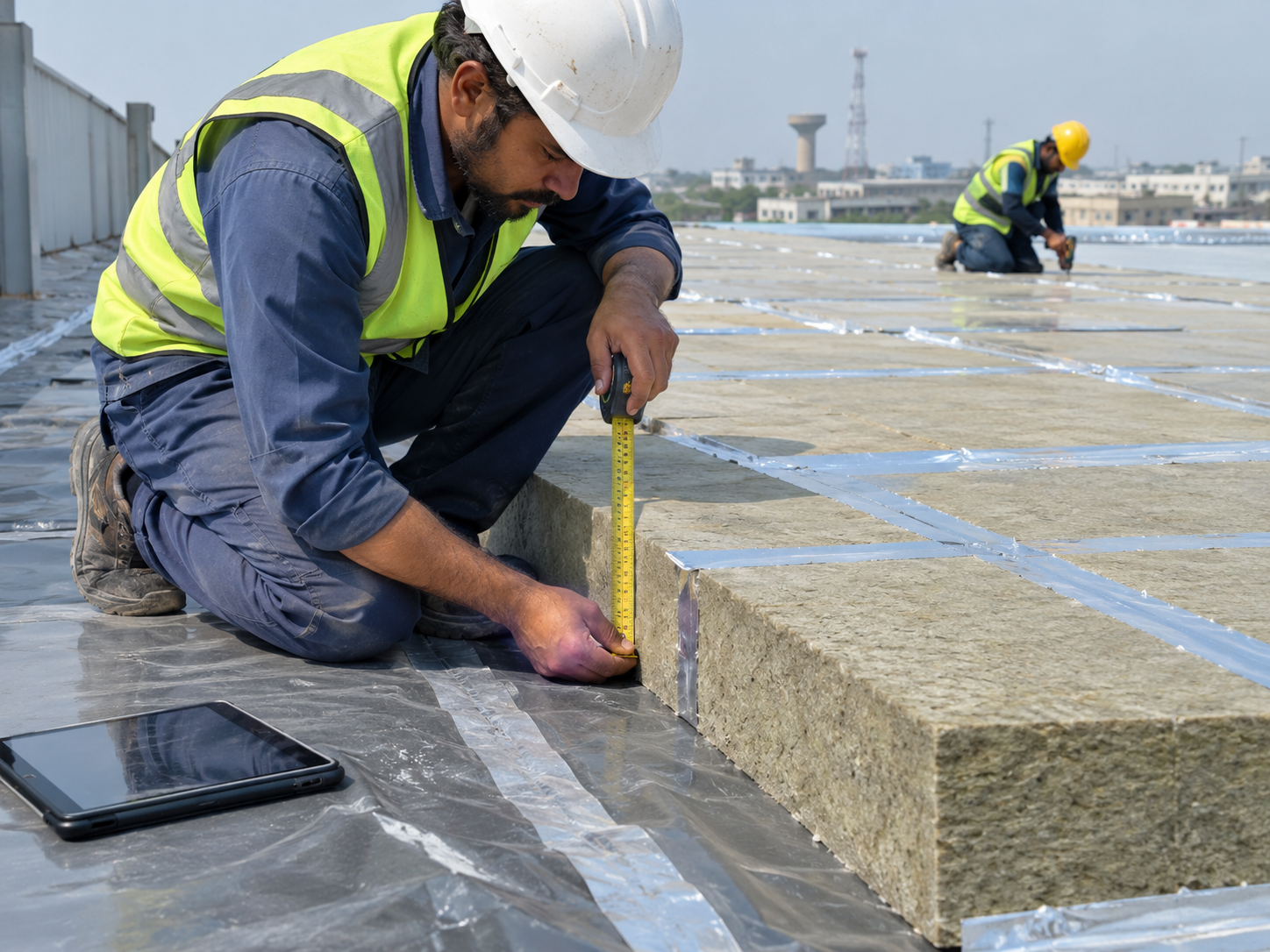
Rigid board insulation run the risk of cracking at movement joints if installed as a continuous layer on either side of a movement joint, which can create issues depending on the type of building construction.
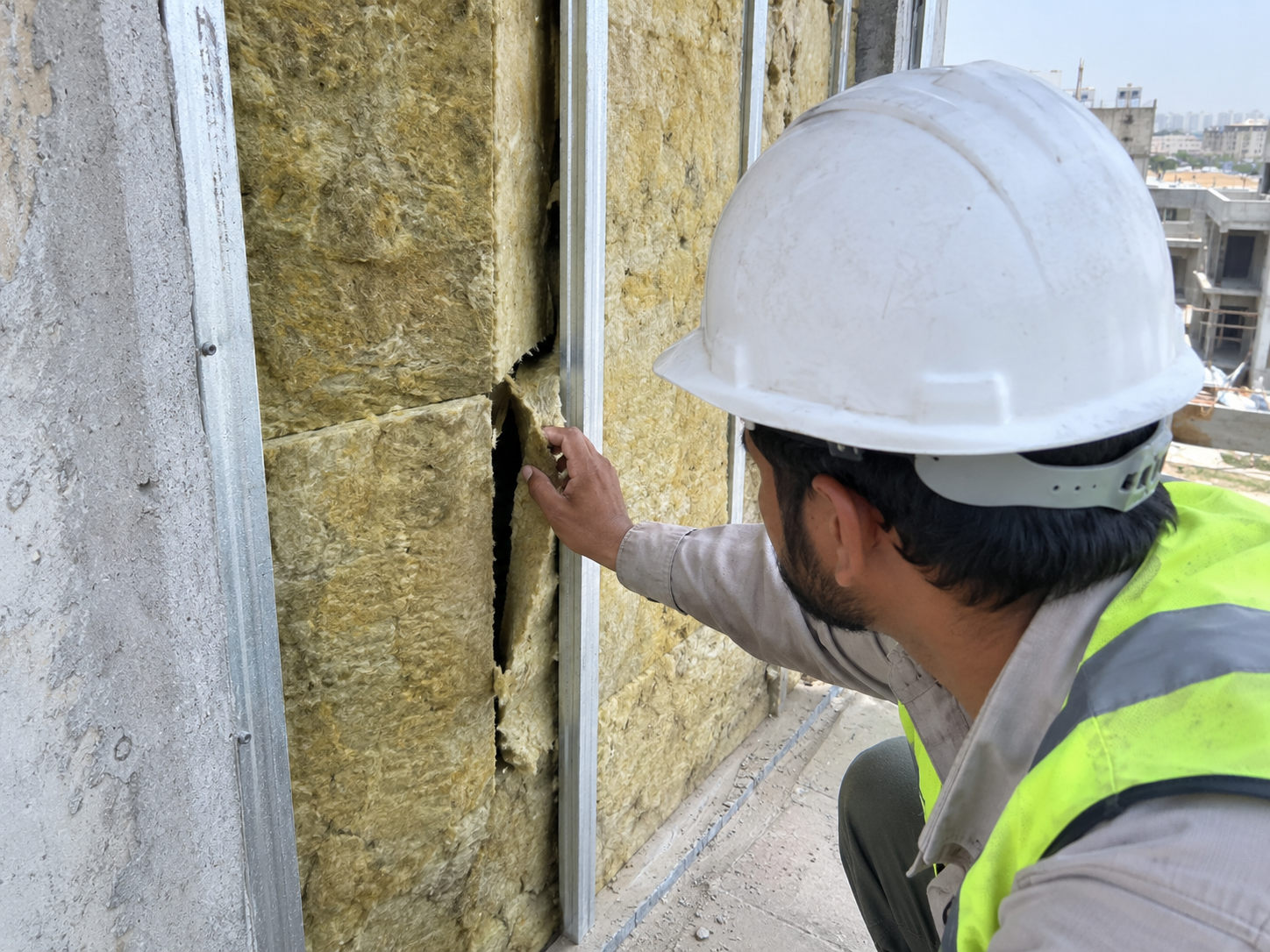
In a rigid frame building, a cracked piece of insulation or its vapor retarder might simply be an annoyance or loss of performance, but in a building with fire-rated assemblies, it can potentially create a breach in the fire-resistance rating. Flexible batt insulation such as rockwool are less likely to be compromised by minor movement, due to the fibers rearranging rather than cracking when pressure is imposed on them, meaning they can be a better choice for such applications, including at wall-to-frame intersections.
Infill Wall Considerations
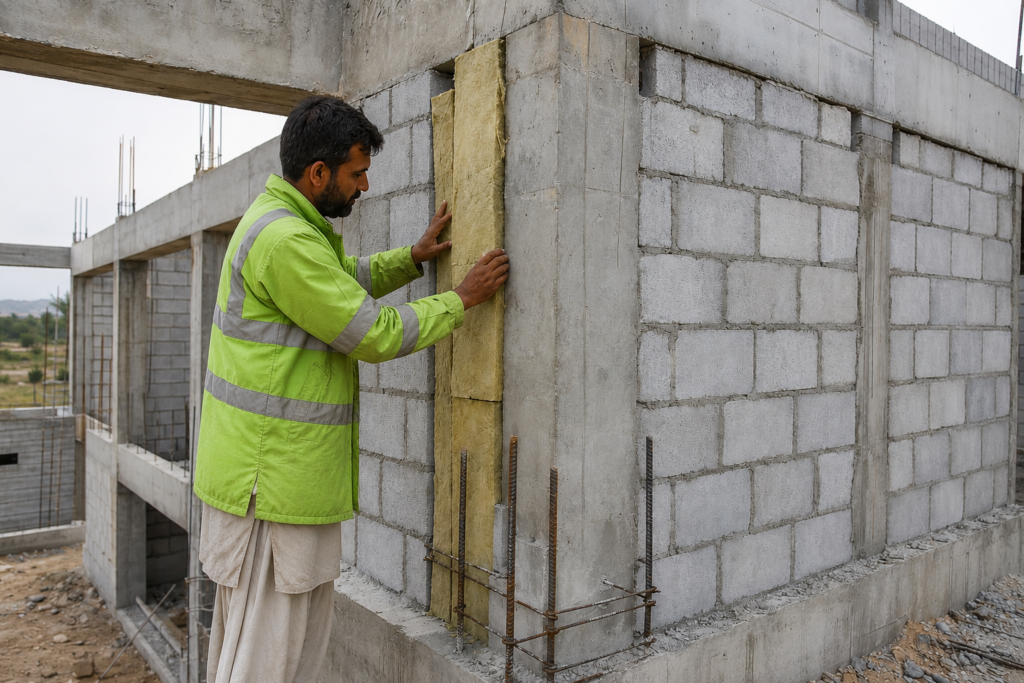
Buildings in Pakistan are, traditionally, built using reinforced concrete frames with masonry infill walls, and this building type has known vulnerabilities in seismic events. While a properly constructed building made using this method is designed to perform well in an earthquake, its masonry infill walls are unlikely to withstand the stress imposed on them without cracking, bulging, or even rolling out of place. This means that insulation either on or within these walls must also be designed to withstand similar stress without presenting additional hazards.
For example, external insulation fixed directly on or within the infill wall must use fixings and detailing that can withstand the additional movement, as compared to a similar insulation installation fixed directly on the main building frame. If done incorrectly, such an insulation system risks becoming detached or sheared at the wall/infill interface during an earthquake, potentially creating falling debris on the building’s exterior, which poses a direct hazard to life and limb during the event.
Fire-rated constructions are particularly vulnerable in this capacity, as the additional measure of a continuous insulation layer for fire-resistance is compromised by the same movement. A fire-rated compartment wall that is able to withstand a fire for a given period of time but is only able to withstand minor movement risks finding itself unable to withstand both during an earthquake, potentially presenting additional hazards post-event during recovery efforts. This is especially true for buildings where continued function is paramount even after an earthquake, such as hospitals and other health-care facilities and schools, which require that occupants be able to evacuate the building even during a seismic event.
This is another area where rockwool’s flexible fibers are an advantage, as the ability of such insulation to withstand minor movement means a wall built with it for fire-resistance is more likely to withstand it with reduced, but still usable, fire-protection capabilities.
Movement Joints And Their Insulation
Junctions between building elements, including movement joints, have to have insulation detailing that spans the width of their movement range so that the service life and performance of the insulation is not compromised by the motion. This typically calls for a flexible insulation and a compressible joint filler in conjunction with it, to allow the insulation to move with the joint without cracking/detaching at lower movement ranges, while being able to withstand the forces imposed on it at higher movement ranges within the allowable range for the joint.
As with all areas of insulation detailing in seismic building sites, movement joints, especially those in buildings with fire-rated assemblies, should also be addressed when determining the continuity and fire-resistance of the insulation.
Post-earthquake Considerations
Buildings in seismic zones, usually following a moderate to severe earthquake, are often inspected to gauge the extent of damage, including areas that would need repair and replacement before the building can return to service. However, I have yet to come across an inspection procedure that includes a review of insulation continuity, even if it is limited to fire-rated assemblies in a large commercial or residential building. I would argue that those should be included, as both thermal and fire protection insulation continuity might compromise a building’s safety during the inspection or the subsequent return to service.
A building’s structural integrity, including its non-structural elements, may be compromised by an earthquake, but that is not necessarily apparent to a visual inspection. In particular, a fire inspection of a building with fire-rated assemblies that have been found structurally sound post-earthquake can easily overlook compromised insulation continuity, particularly if it is not obvious or spans only minor sections of a given assembly. This may well result in a building being returned to service with insulation performance compromised, at best wasting energy and/or presenting additional challenges for an energy audit and retro-commissioning, and at worst presenting additional risks during the next fire.
Seismic Zone Specific Common Issues
The intersection of seismic detailing and insulation continuity presents three chief issues that I see in Pakistan’s construction industry. The first is that architects and insulation subcontractors who specify and install insulation details rarely if ever consider the actual seismic risk of the zone they are working in, applying generic detailing even in areas of high risk. The second is that movement joints are often detailed structurally and water-tight but not insulated, with the continuity of the insulation being overlooked, usually with the on-site subcontractor assuming responsibility for it. Finally, the third chief issue is the belief that insulation is irrelevant to earthquakes due to being a non-structural building element, when in reality its failure can present hazards both during the event and afterwards due to loss of functionality, thermal performance, or becoming projectiles.
Insulation Issues In Seismic Zones In Pakistan
The seismic risk in Pakistan varies considerably from area to area, with earthquake fault lines stretching through the country, affecting KP, AJK, and northern Punjab in particular. As a developing country, Pakistan’s building codes, both structural and insulation, continue to evolve, and as the country’s structural building standards move towards higher seismic tolerances, insulation specifications must do the same. For architectural and structural teams working in high seismic risk areas, engaging early with the insulation subcontractor to discuss seismic-specific considerations for movement joints is a way to future-proof upcoming insulation work while minimizing liability for both parties post-earthquake.
FAQ
Earthquake Resistance And Insulation
Insulation itself does not contribute to a building’s earthquake resistance, as the task belongs to the structural frame and its detailing. However, poor detailing of insulation and its accessories can cause additional issues during and after an earthquake, including secondary hazards such as falling debris, fire resistance loss, and energy loss.
Movement Joints And Insulation
Insulation should be continuous across the building’s movement joints using a flexible insulation material and a compatible filler capable of withstanding the joint’s movement range.
Rockwool And Seismic Detailing
Rockwool’s flexible fiber structure allows for it to withstand minor movement imposed on it, making it a good choice for use at movement joints and wall-to-frame intersections in buildings constructed in high seismic risk areas.
Earthquake And Fire-rated Insulation Failures
An earthquake can compromise a fire-rated insulation wall even if there are no apparent structural damages, such as cracks or bulging in the wall surface. Movement can cause minor damages to the wall, such as cracking in the insulation or its vapor retarder, which in turn can compromise the fire-resistance rating of the assembly. This is an additional factor to consider when inspecting buildings with fire-rated insulation after an earthquake, especially when it comes to larger commercial buildings. In addition to the increased risk to occupants during the quake, a compromised fire-rated insulation wall may present additional risks to occupants post-earthquake depending on the circumstances.
Seismic Risk Areas In Pakistan And Insulation Detailing
Seismic risk in Pakistan varies depending on the location, with KP, Azad Jammu and Kashmir, and northern Punjab being in higher seismic risk areas. Those areas in particular should consider additional seismic detailing when it comes to continuous insulation, particularly in regards to movement joints.
Contact Pakistan Insulations today for a free consultation and quote.
Phone: +92-21-34529722
Email: [email protected]
Website: www.pakinsulation.com