R-Value vs U-Value – How To Read An Insulation Spec Sheet In Pakistan
I have seen many clients seeking a second opinion on the insulation spec sheet because the first one compared apples to oranges or thought that higher is always better for the values mentioned. The wrong evaluation of these values is extremely easy to make, and even if one is certain that one has done it right, the building can still end up underperforming due to its incorrect assumptions about the assembly.
What The R-Value Actually Describes
The R-value is a measure of thermal resistance, describing how well a material resists conducting heat. The higher the value, the better the insulation. It is a unit based on the thickness of the material, so a greater layer will generally have a higher value. On the other hand, it says nothing about the performance of the whole building assembly.
Therefore, what most Pakistani suppliers list as their R-value is the resistance of their insulation material at a given thickness, based on standard lab tests. It is valuable information that is needed to calculate the building assembly’s performance, but it is only one factor that goes into it.
What The U-Value Actually Describes
Meanwhile, the U-value describes the same property of materials but in an inverted manner. It states how well the whole assembly conducts heat, making it directly indicative of the performance of the building construction. Therefore, the lower the number, the better, and it is this number that needs to be known for the purposes of energy performance calculations, such as those required for EDGE and LEED certifications.
Two building assemblies with insulation products with the same R-value can potentially have vastly differing U-values, depending on the proportion of insulated and uninsulated parts.
Why This Is Important In Pakistan
As mentioned, the Pakistani suppliers will want to quote an R-value, since it is a larger number that sounds better, and it is easier to test since it does not require considering the whole building assembly. Meanwhile, when designing the building and calculating its performance, the designer needs the U-value of the whole assembly, not the R-value of the material used to make it.
The wrong product comparisons can be made when the procurement team sees that the R-value of one product is lower than the other, when, in fact, the quoted R-value of the other product is at a greater thickness, or when the actual U-value of the building assembly would be close enough due to the smaller thickness of the first, uninsulated portion.
When to Use What In The Local Spec Sheet
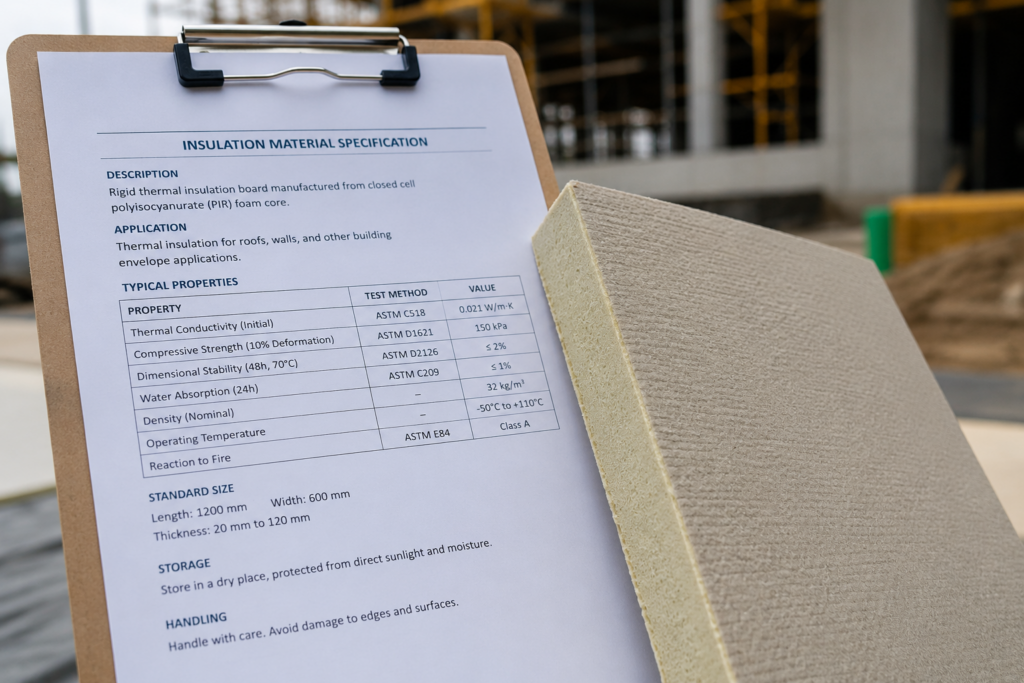
When comparing products, the thickness at which the R-value is quoted is as important as the value itself. A spec sheet that lists an R-value without noting the thickness at which it was tested is not very useful at comparison.
Next, it is important to note whether the number describes the performance of the whole assembly or just a material. A correctly quoted U-value describes an assembly, so, when seeing it in a spec sheet, one should ask whether it was based on any particular construction or not. Meanwhile, when one sees an R-value, there is a very good chance that it describes the performance of the material on its own, not as part of the assembly. When designing the building, the designer would need to calculate the U-value based on this R-value, the thickness of the insulation layer, and other factors that go into the construction.
Other things to consider are lambda value (thermal conductivity), which may be hidden in the description. It is a property of the material, similar to density, and it is a good metric to base comparisons on when the R-value is not indicative of performance. It is generally lower for fiberglass than for rockwool, but it varies greatly between manufacturers, with values typically ranging from roughly 0.03 to 0.05 W/m·K for fiberglass and 0.033 to 0.4 W/m·K for rockwool, depending on the material’s density. The lower the value, the better.
It is also important to be wary of nice, round numbers quoted without any standards mentioned. A spec sheet with a number that supposedly adheres to a certain standard, mentioned elsewhere on the sheet, is much more trustworthy. It is good to remember that the actual testing process will follow a standard defined by the certifying body anyway, so numbers that fail to mention it should be used with caution.
Where Local Buildings Usually Fail To Meet The Requirements
Buildings usually perform worse than expected due to thermal bridges – points in the building’s construction where heat is conducted through it much faster than through the insulation layer, rendering it largely ineffective. This happens when there are junctions between the insulation and concrete columns or other construction parts, such as when these are used to reinforce the building frame. Columns placed within the walls are thermal bridges as well, depending on their construction.
This is a more widespread problem than one might think in the local context, since columns are the mainstay of local constructions, and are often placed in the middle of walls in insulated buildings. A spec sheet, no matter how detailed, cannot fix thermal bridges in the construction, and it is why certifying bodies are now asking for specifics on them, or whether they are even present in the design.
A Simple Method To Use When Reading The Spec Sheets From Local Suppliers
When comparing products, ensure that the value quoted refers to the performance of the same construction. If two products are compared at the same thickness, the one with a lower lambda value will have a higher R-value, and this should be reflected in the numbers on the spec sheet. If it is not, it is best to contact the supplier and request the actual test report. This trick works for R-values, but not U-values, since they already take into account the whole construction.
Meanwhile, the comparison of building construction performance should be done using U-values. It is important to specify whether it refers to the whole construction or not and, if it does, what construction details were used to calculate it, as this will be necessary to compare it to other options, such as one using glass-wool insulation.
Frequently Asked Questions
What is the difference between an R-value and a U-value?
The R-value describes a material’s resistance to conducting heat. The higher the value, the better the insulation. U-value describes the same property in an inverted manner, stating how well the material conducts heat. Therefore, a lower U-value indicates a better insulating capability.
Which value should I use when comparing insulation products?
When comparing insulation products at a set thickness, either R-value or lambda value can be used. Otherwise, when comparing assemblies, U-value is necessary. If a supplier lists an R-value in their spec sheet, it is describing the performance of the insulation material on its own, not as part of the construction. A U-value, on the other hand, describes the performance of the whole construction, so it is necessary when comparing constructions.
Why might a supplier only list an R-value?
An R-value is easier to determine since it only describes the performance of an insulation material. A U-value, on the other hand, requires calculating the performance of the whole building construction, which can vary depending on the building’s specifics. Therefore, while a supplier can list an R-value for their material, a project-specific U-value should be requested from the designer when comparing constructions.
Can a product with a lower R-value have a better performance than one with a higher R-value?
Yes, if the construction differs. This is especially true for thermal bridges, which can drastically reduce the insulation performance of the whole construction.
What is lambda value, and how is it related to R-value and U-value?
Lambda value is a measure of thermal conductivity, and it is a physical property of materials, like density. It is related to R and U-values since they are calculated using it. It is useful in comparing the performance of materials since it does not depend on their thickness, unlike R-value, which varies depending on the thickness of the material used in a construction.
Contact Pakistan Insulations today for a free consultation and quote.
Phone: +92-21-34529722
Email: [email protected]
Website: www.pakinsulation.com