Textile Mills Rockwool Roof Insulation
The textile mills are warm places. All too readily badly insulated roofs lose the large amounts of heat generated by spinning machines, weaving looms, dyeing vats and constant industrial activity. For mill operators working with narrow margins and rising energy costs, roof insulation isn’t a luxury. It’s a real need.
Rockwool (mineral wool) is now the standard industrial roofing insulation material in Pakistan and worldwide. It delivers thermal performance, fire resistance and acoustic management all in one package. This tutorial covers why Rockwool roof insulation is the ideal solution for textile mills, how it works, and what to consider before installation.
Why Textile Mills Are Having a Roofing Insulation Problem
Industrial textile mills have double problem. Friction heat is created by high speed looms and spinning machines. Steam is employed in dyeing and finishing to a great extent. And in Pakistan, temperatures outside the summer may surpass 40°C, sending heat into the building from above, and up from below from equipment.
The result? Poor working conditions, overworked HVAC systems, and massive energy waste. Roofs tend to be the most ignored section of the thermal envelope in older mills, yet they account for an inordinate amount of heat gain in flat or low-pitched industrial buildings.
Uninsulated metal sheet roofing (common to pre-engineered structures) is a heat collector all day long. A good layer of insulation above or below the roof deck can dramatically alter that equation.
Why Rockwool is the Best Option for Textile Mill Roofs
There are several insulating materials on the market: fiberglass, polyurethane foam, expanded polystyrene. Each has its place, but Rockwool offers certain benefits that are especially relevant in a textile mill context.
Thermal performance at constant load
Textile mills operate long shifts, often 12 to 24 hours a day. Rockwool retains its insulating properties at high temperatures. It does not melt, sag or lose structural integrity when exposed to extended heat – delivering a reliable product for the entire service life of an industrial roof.
Fireproofing
Textile mill facilities are highly vulnerable to fires. Raw fiber, fabric stock, lubricants and chemical finishes are all combustible materials. Rockwool is non-combustible – it can tolerate temperatures beyond 1,000°C without igniting or giving out harmful gasses. This can help prevent the spread of fire, giving more time to escape and limiting damage to equipment and merchandise.
Acoustical Control
There is a lot of noise in the textile manufacturing. The continual noisy environment produced by hundreds of looms working concurrently affects worker health and productivity. Rockwool has a strong fibrous structure, which absorbs sound waves and so minimizes the transmission of airborne noise through the roof.
Moisture & Humidity Resistance
Dyeing and finishing activities produce steam and high humidity. Rockwool is hydrophobic – it doesn’t absorb water, it repels it. This makes it ideal for the humid interior atmosphere of wet processing rooms in textile mills.
Rockwool Roof Insulation for Textile Mills
The installation process depends on the roof type. In Pakistani industrial building, the two most popular types of roofs are PEB (metal sheet roofing) and reinforced concrete flat roofs.
Metal Sheet Roofing (PEB)
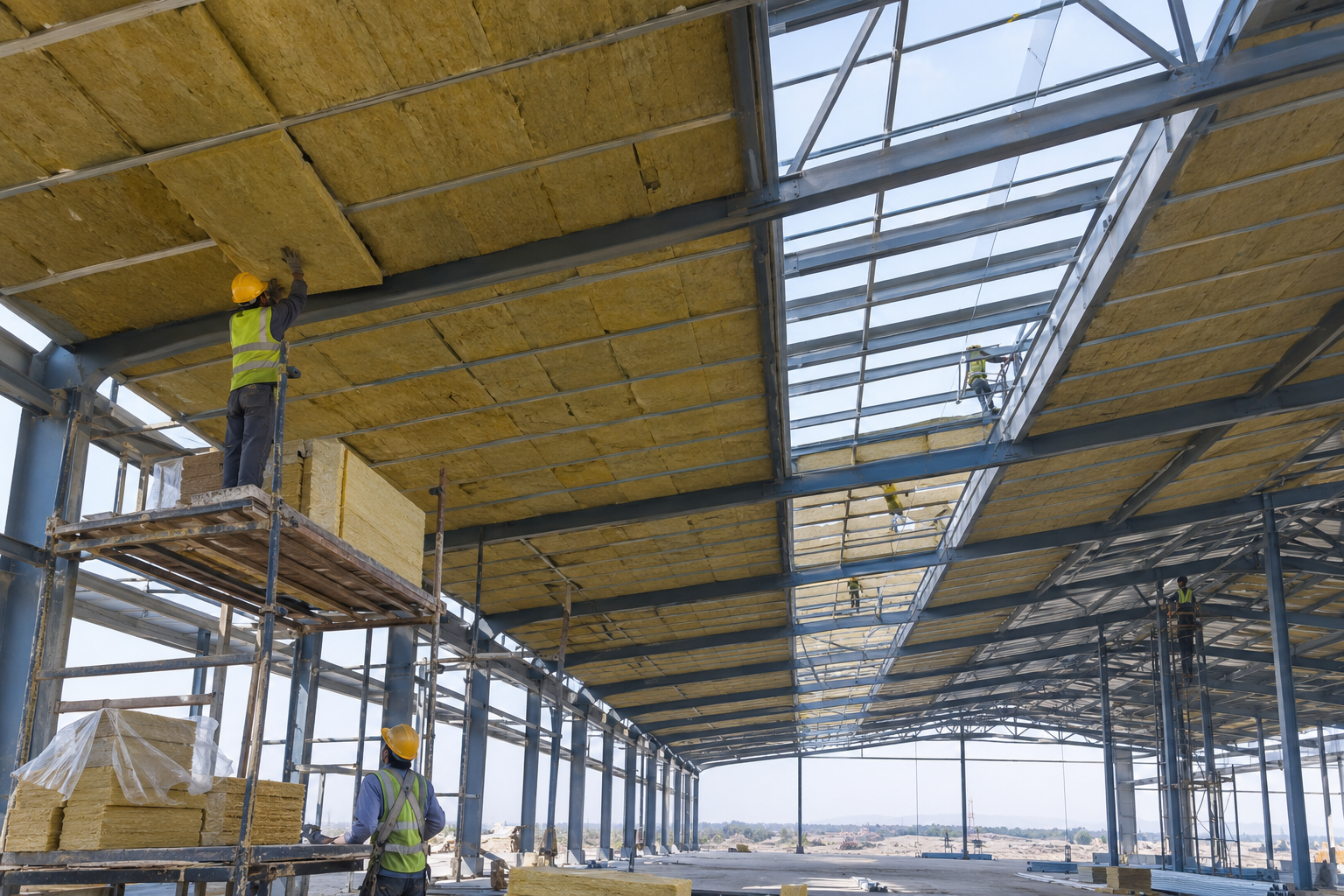
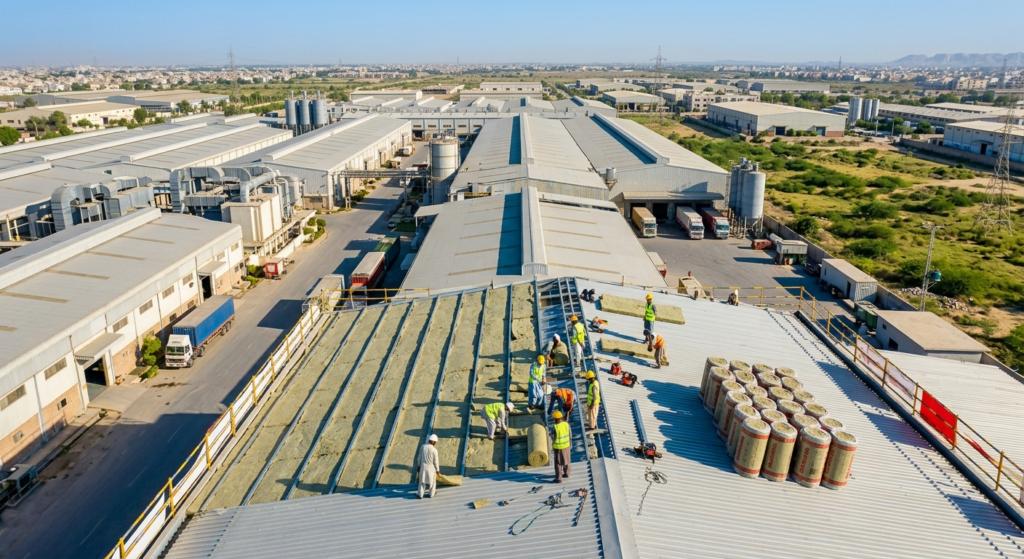
New construction of textile mills is commonly done in pre-engineered structures. Rockwool blanket or slab insulation is fitted between the outer metal sheet and an inner liner panel, supported on the top flanges of purlins.
The thickness is important. A 50mm Rockwool blanket provides a significant increase over no insulation but 75mm to 100mm yields substantially stronger thermal resistance and is often recommended for buildings running energy-intensive processes 24/7.
Flat Reinforced Concrete Roofs
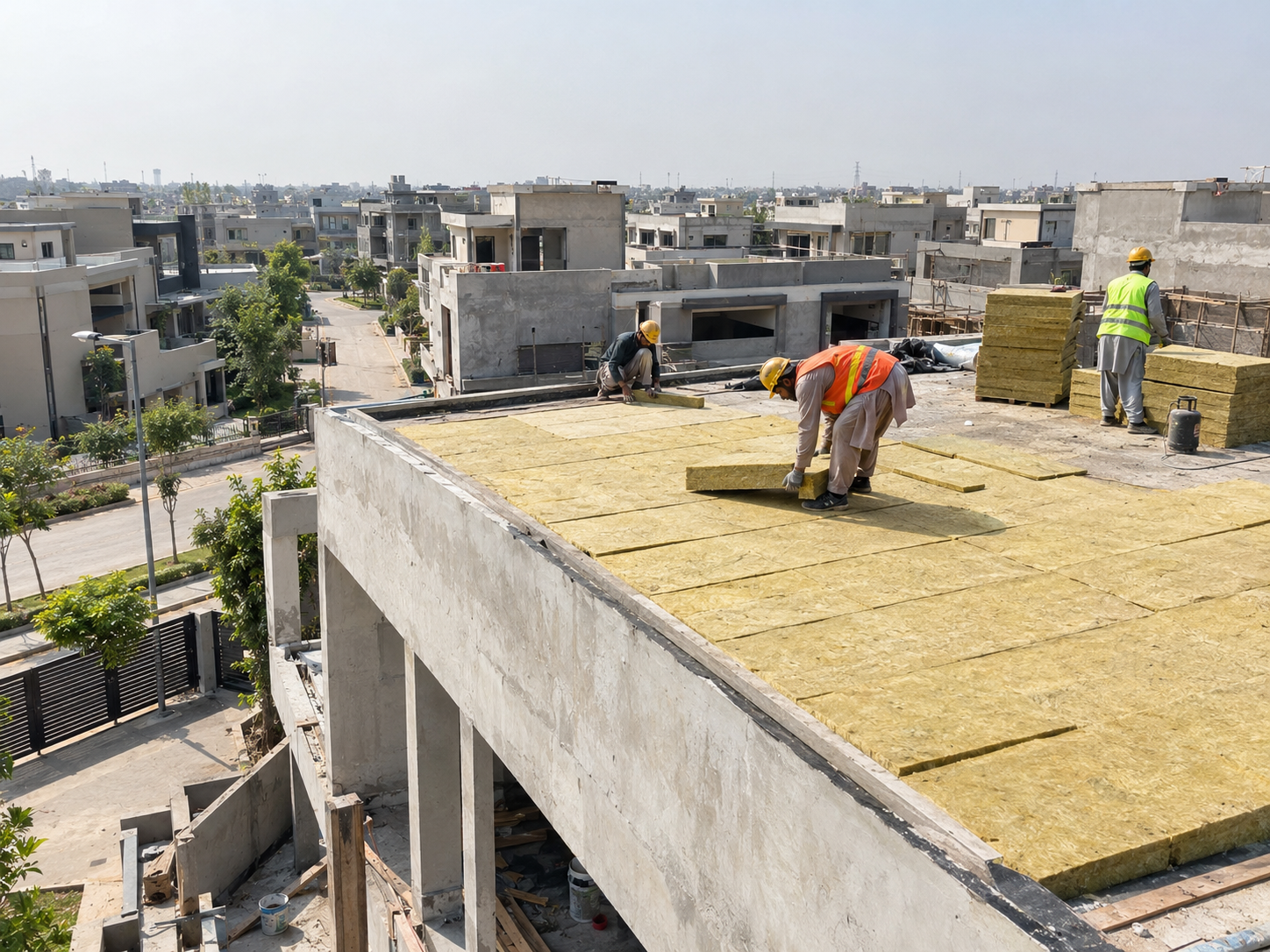
Many of the older mill buildings have flat concrete roofs. Rigid Rockwool boards are placed on top of the structural slab, topped with a waterproofing layer and a protective screed. This ‘warm roof’ configuration maintains the structural slab above the dew point temperature lowering the chance of condensation occurring within the roof structure.
For humid situations, a vapor control layer on the heated side of the insulation is also recommended to prevent moisture migration into the insulation layer.
Rockwool Roof Insulation: How much energy can textile mills save?
A well-insulated roof reduces the rate at which heat enters the structure in summer and departs in winter, so cooling and heating systems don’t need to work as hard to keep the building at the proper temperature. In air-conditioned or evaporatively cooled mills for sensitive processes like as yarn conditioning or computerized weaving, reduced roof heat gain correlates directly to reduced compressor run times and electricity usage.
Pakistan Insulations (Pvt.) Ltd. is Pakistan’s first manufacturer of Rockwool insulation. Since its inception in 1986, the company has accumulated over 40 years of expertise in the sale and installation of roof insulation in industrial projects such as power plants, refineries and manufacturing facilities.
What to consider while selecting Rockwool for industrial roofs
Not every Rockwool is made the same. When ordering insulation for a textile mill roof, consider:
- Density: Boards with a higher density (80–120 kg/m3) are used for roofs where a compressive load may be placed. Metal sheet roofs are best covered with blankets of lower density.
- Thermal conductivity (λ value): The lower the lambda value, the greater the insulating performance for a given thickness. Always refer to the technical datasheet from the manufacturer.
- Fire rating: Look for items with a non-combustible rating (Class A1 or A2, according to applicable criteria).
- Faced vs. unfaced: Foil-faced Rockwool products provide an extra radiation barrier for metal roof applications.
- Thickness: Calculate thickness based on the U-value needed, not only what suits the present roof profile.
How to Find a Competent Insulation Contractor
Material quality is only good if the installation is done appropriately. Thermal bridges can occur due to poor insulation fit, for example around structural members, compressed insulation, or the lack of vapor control layers, which can have a negative impact on the performance of the whole system.
When selecting a contractor, check for:
- Experience primarily in industrial roofing projects
- Experience with the specific Rockwool items being installed
- A written scope of work specifying material specifications, installation technique declarations and quality control checkpoints
When to Insulate
It’s easier to add insulation to an existing roof if the mill is already intending to change its sheeting or do waterproofing work because the roof is already being accessible and partially demolished, decreasing marginal cost considerably.
New construction projects have the most flexibility. Choosing Rockwool insulation at the design stage allows the structural system and purlin depths to be designed for the specified insulation thickness without the sacrifices associated with retrofitting.
Invest in Your Roof to Invest in Your Mill
The roof of a textile mill is one of its biggest surfaces and one of the most important sources of energy exchange with the environment. Rockwool roof insulation solves the core concerns of constant heat, fire danger, moisture and noise in industrial textile environments with one durable, low-maintenance solution that pays dividends for decades.
If you want to decrease operating costs, enhance working conditions and safeguard your mill from potential energy price hikes, then call Pakistan Insulations (PIL) and we will provide you a tailored insulation suggestion for your project.
Frequently Asked Questions (FAQs)
What thickness of Rockwool is suggested for Pakistan textile mill roofs?
For industrial installations in the climate of Pakistan, 75mm to 100mm Rockwool blanket insulation is often suggested for metal sheet roofing. For flat concrete roofs, 50mm to 75mm stiff Rockwool board is usual – the optimal thickness depends on the needed U-value and energy efficiency goals of the building.
Can Rockwool be put in an existing textile mill roof without any substantial structural modification?
Yes. Rockwool can be installed into most existing roof structures. Metal sheet roofs can have insulation re-sheeted. For flat concrete roofs, stiff Rockwool boards are installed directly on the existing slab, then coated with a waterproofing membrane.
Is Rockwool insulation safe to use in a fire-risk environment like a textile mill?
Rockwool is non-combustible and can sustain temperatures of above 1,000°C. This makes it one of the safest insulating alternatives for fire sensitive environments like textile industries where raw fiber, fabric and chemical finishes are present.
In the humid atmosphere of dyeing and finishing regions, how does Rockwool perform?
Rockwool is hydrophobic, i.e. it rejects water instead of absorbing it. This maintains thermal performance over time in humid industrial environments. A vapor control layer on the hot side of the insulation is also advised to avoid moisture migration.
Where to find Rockwool insulation for industrial roofs in Pakistan? Who is selling and installing Rockwool insulation for industrial roofs in Pakistan?
Pakistan Insulations (Pvt.) Ltd. (PIL) is the main Rockwool producer in Pakistan, established in 1986. Throughout the country, PIL distributes and fits Rockwool insulation for industrial purposes, such as roofs of textile mills.
Contact Pakistan Insulations (PIL)
- Phone: +92-21-34529722
- Email: [email protected]
- Website: www.pakinsulation.com