Acoustic Insulation in Pakistan: Why Sound Control Matters for Factories and Offices
Noise is one of the most consistently underestimated problems in Pakistani industrial and commercial construction. Factories built next to residential areas, offices where you can’t hold a conversation without raising your voice, generator rooms with no acoustic treatment — these aren’t just discomfort issues. Excessive noise affects worker productivity, causes long-term hearing damage, creates regulatory and community relations problems, and in some industries, is a compliance failure.
Acoustic insulation — specifically Rockwool — is the most practical, cost-effective solution for most of these situations. But it’s widely misunderstood. This post explains how sound behaves in buildings, what Rockwool actually does to it, where acoustic treatment makes the most difference, and what gets specified wrong in Pakistani projects.
Sound Absorption vs Sound Insulation: The Difference Matters
The two terms get used interchangeably but they describe different things, and confusing them leads to wrong specifications and disappointing results.
Sound Absorption
Sound absorption reduces the amount of sound energy that bounces around inside a space. When sound hits a hard surface — concrete, glass, metal — most of it reflects back into the room. When it hits an absorptive material like Rockwool, the fibrous structure converts the sound energy to a tiny amount of heat. The result is less reverberation, shorter echo times, and a quieter, clearer acoustic environment inside the room.
This is what acoustic ceiling tiles, wall panels, and Rockwool baffles do. They don’t stop sound from entering or leaving the room — they reduce the buildup of reflected sound within it. The measure is NRC (Noise Reduction Coefficient), where 1.0 means all sound is absorbed and 0 means all is reflected. High-density Rockwool boards typically achieve NRC 0.85 to 0.95.
Sound Insulation
Sound insulation blocks sound from passing through a wall, floor, or ceiling from one space to another. The measure is Rw (weighted sound reduction index) in decibels. A partition with Rw 45 dB reduces the sound passing through it by 45 dB which in practice means a loud noise on one side sounds quiet on the other.
Sound insulation depends primarily on mass (heavier structures block more sound) and decoupling (separating the two faces of a wall so vibration can’t transfer directly through the structure). Rockwool contributes to both: it adds mass and, critically, it absorbs the sound energy that enters the cavity of a double-skin wall before it can set the other face vibrating.
A common mistake: specifying acoustic ceiling tiles to reduce noise coming through a wall. Ceiling tiles are absorbers — they improve the room acoustics. They do very little to block sound transmission from an adjacent space. The two problems require different solutions.
How Rockwool Solves Acoustic Problems
Rockwool is effective for acoustic applications for the same reason it works thermally — its fibrous structure traps and dissipates energy. Sound energy entering a Rockwool layer causes the fibres to vibrate microscopically, converting acoustic energy to heat. What emerges on the other side is a fraction of what entered.
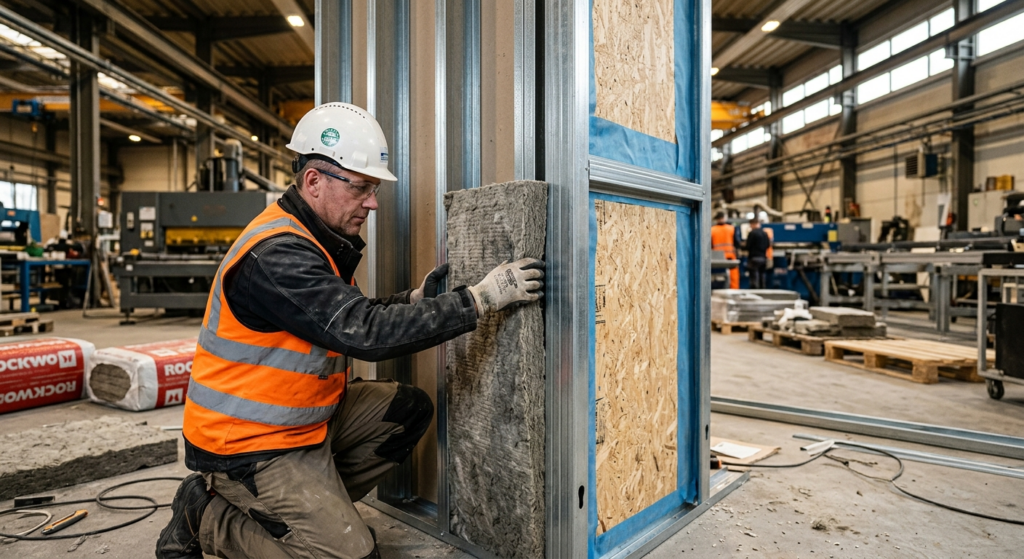
In a double-skin wall or partition — two layers of board or cladding with a Rockwool-filled cavity — the performance is dramatically better than either the mass alone or the cavity alone would suggest. The cavity decouples the two faces. The Rockwool prevents the cavity from acting as a resonant chamber that amplifies certain frequencies. The combination of mass, decoupling, and absorption is why LGS + Rockwool wall assemblies outperform brick walls of significantly greater mass for sound insulation.
Density matters for acoustic performance. Low-density Rockwool (under 30 kg/m³) is good for thermal insulation in wall cavities but provides moderate acoustic performance. Higher-density Rockwool (60 to 100 kg/m³) provides better sound absorption and is used in acoustic panels, studio walls, and applications where sound reduction is the primary requirement.
Acoustic Applications by Building Type
| Application | Problem | Solution | Target Performance |
|---|---|---|---|
| Factory near residential area | Noise breakout to neighbours | Rockwool in roof/wall + mass cladding | 45–50 dB reduction |
| Generator / plant room | Machinery noise in building | Rockwool enclosure + floating floor | 40–55 dB reduction |
| Open-plan office | Speech distraction | Rockwool ceiling tiles + baffles | NRC 0.80–0.95 |
| Recording / broadcast studio | External noise + internal echo | Decoupled LGS walls + Rockwool | Rw 55–65 dB |
| Hotel / apartment party wall | Airborne sound between units | Rockwool in LGS double stud wall | Rw 50–60 dB |
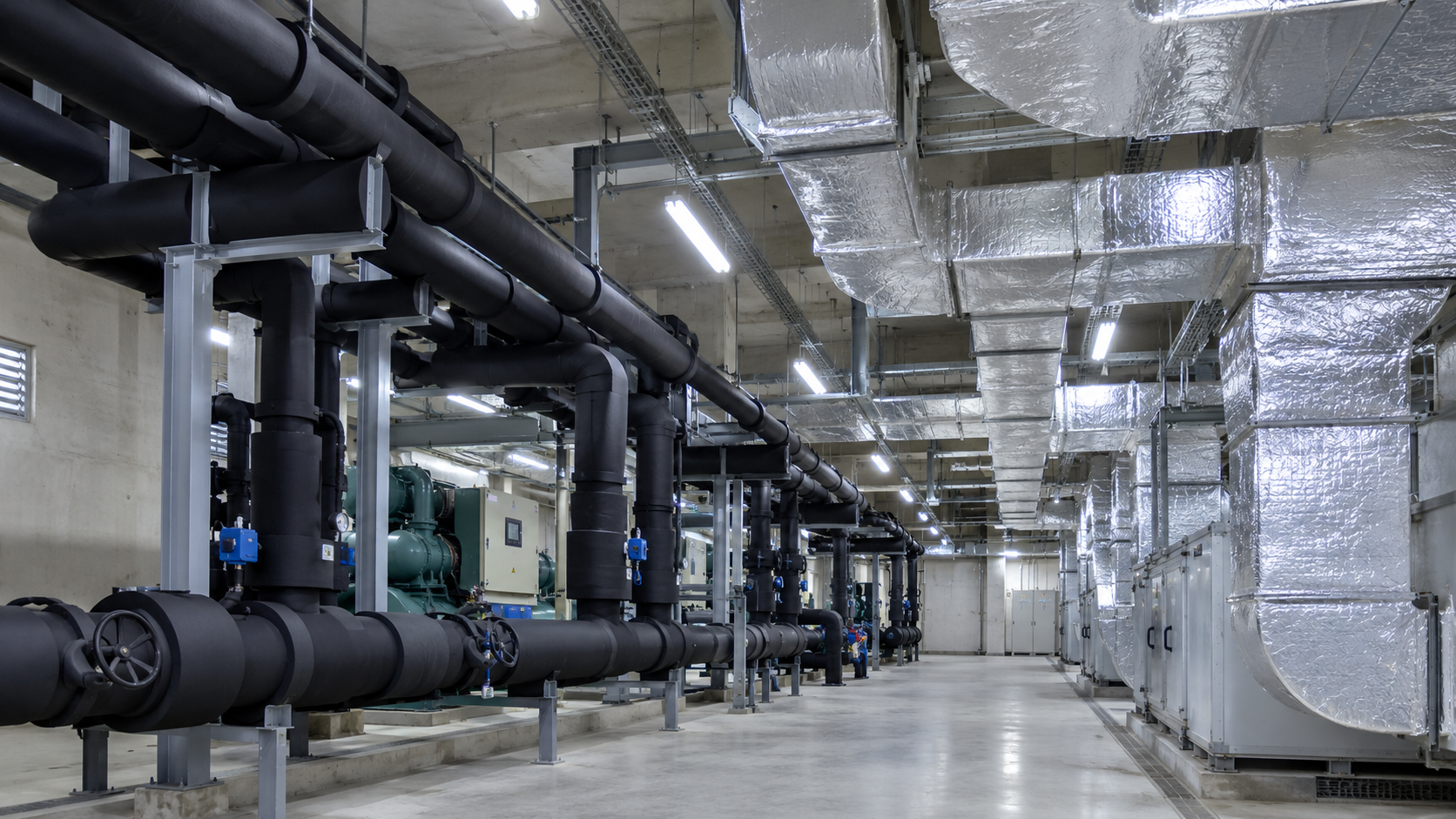
| Industrial HVAC ductwork | Fan/air noise in occupied spaces | Rockwool duct liner / lagging | 10–25 dB duct attenuation |
Industrial Noise Control: Factories and Manufacturing
Pakistan’s environmental and labour regulations set noise limits — 85 dB(A) for 8-hour occupational exposure, and lower thresholds for residential areas adjacent to industrial facilities. Many factories exceed these limits without any acoustic treatment, creating both a compliance risk and a genuine health issue for workers.
Roof and Wall Insulation for Noise Breakout
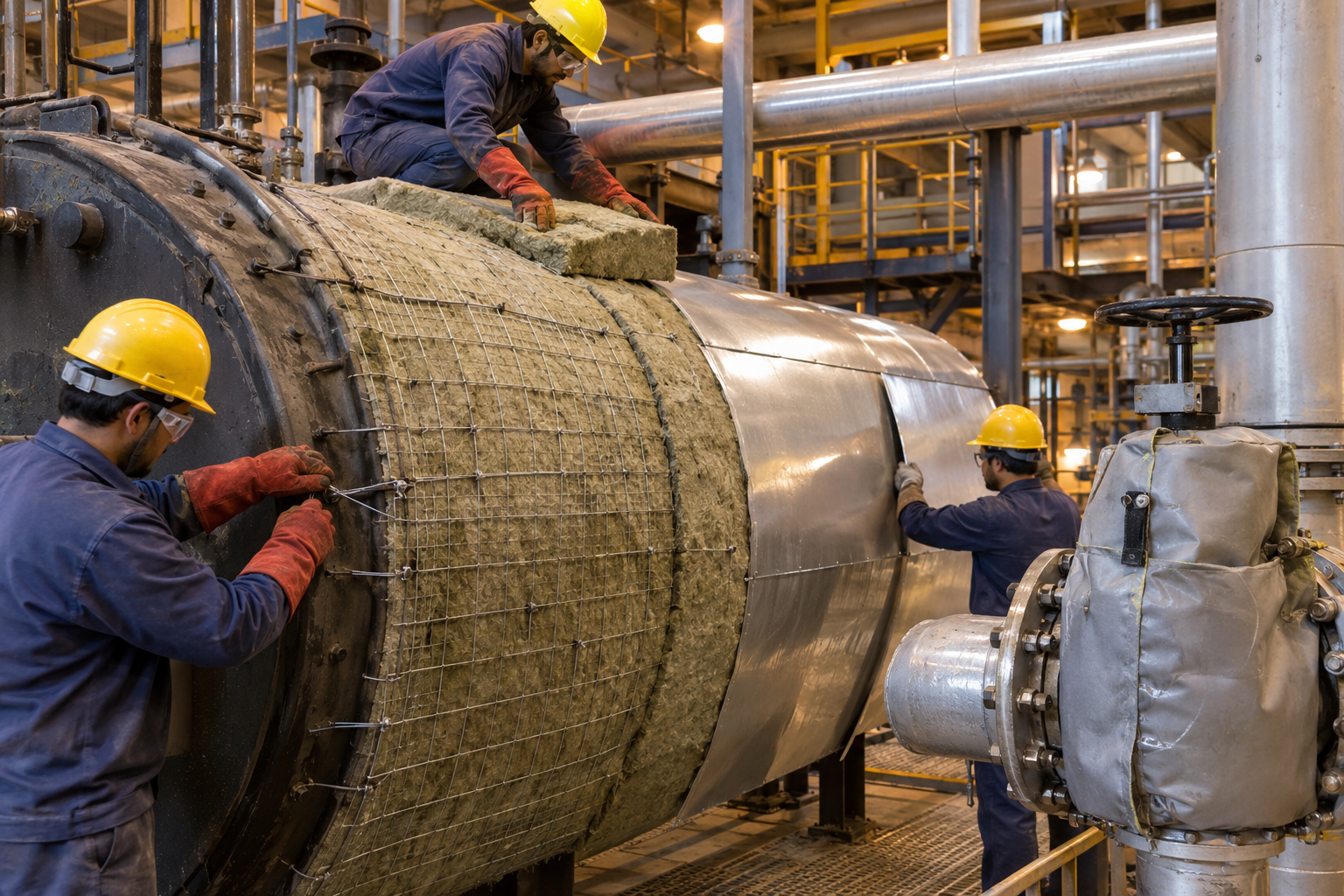
In a large industrial shed, the main noise source is usually the machinery. The noise travels through the air and sets the roof and wall cladding panels vibrating, which re-radiates the noise to the outside. Rockwool between the inner and outer cladding layers of a sandwich panel, or fitted between purlins and secondary cladding in a standard PEB, adds both mass and absorption to the envelope, significantly reducing the noise that escapes the building.
For factories near residential areas in Pakistan — which is common given how industrial and residential zoning interleave in Pakistani cities — this is increasingly a community relations necessity as much as a regulatory one.
Acoustic Enclosures for Machinery
Where a specific piece of equipment is the dominant noise source — a compressor, a generator, a high-speed press — building an acoustic enclosure around it is often more cost-effective than treating the entire building. Rockwool-lined enclosures with appropriate ventilation can reduce noise from a single machine by 15 to 25 dB, which is the difference between a regulatory exceedance and compliance.
The critical detail is that the enclosure must be complete — any gap, any unsealed penetration for pipes or cables, any vibrating panel not damped correctly, significantly reduces the achieved performance. A well-designed but poorly constructed enclosure achieves half its potential noise reduction.
Generator Rooms
Diesel generators are standard backup power for commercial and industrial facilities in Pakistan. A generator in an unlined room produces noise levels of 90 to 105 dB(A) at one metre. Rockwool-lined walls, ceiling, and door, with vibration isolators under the generator set and acoustic louvres on ventilation openings, can reduce this to 65 to 75 dB(A) at the room boundary — acceptable for most commercial settings.
Office and Commercial Acoustic Design
Open-Plan Offices
Open-plan offices in Pakistan suffer from two acoustic problems: too much reverberation (hard surfaces everywhere create long echo times) and too little speech privacy (conversations carry across the entire floor). Rockwool acoustic ceiling panels and wall absorbers address the reverberation problem directly. Acoustic screens between workstations and white noise systems address speech privacy.
The target for an open-plan office is a reverberation time of 0.4 to 0.6 seconds and a speech transmission index (STI) between workstations of below 0.5. Without acoustic treatment, a hard-surface office typically has reverberation times of 1.0 to 1.5 seconds — noticeably echoey and fatiguing to work in.
Meeting Rooms and Boardrooms
Meeting rooms need two things: good internal acoustics (low reverberation, good speech intelligibility) and adequate sound insulation from adjacent spaces (so conversations stay private and external noise doesn’t intrude). Rockwool in the partition walls and ceiling provides both — absorption within the room and insulation from outside.
A common failure in Pakistani office construction is building meeting room walls that stop at the suspended ceiling rather than continuing to the structural slab above. Sound travels easily over a partition that doesn’t reach the ceiling — the acoustic performance of the wall is irrelevant if there’s an open path over the top.
Hotels and Residential Buildings
Guest satisfaction in hotels is strongly correlated with acoustic quality — noise from corridors, adjacent rooms, mechanical plant, and external sources is one of the top complaint categories in hospitality. Rockwool in LGS party walls between rooms, acoustic underlays under hard flooring, and correctly specified room doors make a measurable difference to guest experience and review scores.
What Gets Specified Wrong on Pakistani Acoustic Projects
- Confusing absorption with insulation: Acoustic ceiling tiles in a noisy factory improve the room acoustics but don’t stop noise leaving the building or travelling between spaces. Match the solution to the actual problem.
- Partitions that don’t reach the slab: Sound travels over, under, and around partitions through any continuous airpath. A wall that stops at a suspended ceiling tile provides essentially no sound insulation from the space above.
- Wrong Rockwool density: Low-density thermal Rockwool in a wall cavity provides limited acoustic benefit. Acoustic applications need higher-density products specified for sound absorption or insulation.
- Flanking paths ignored: Sound travels through structure — floors, ceilings, connecting walls — around a well-insulated partition. Acoustic design needs to address all the paths, not just the direct one.
- No vibration isolation on machinery: Isolating structure-borne noise requires anti-vibration mounts and floating floor systems — not just acoustic insulation on the walls. Both are needed.
- Gaps and penetrations unsealed: A single 1cm gap around a pipe penetration in an acoustic partition reduces its performance by 10 to 15 dB. Every penetration must be sealed with acoustic sealant or fire-rated acoustic putty.
Dealing with a Noise Problem in Your Facility?
Pakistan Insulations manufactures Rockwool acoustic insulation products for industrial, commercial, and residential applications — including acoustic blankets, rigid boards, pipe lagging, and duct liner. We’ve been supplying and installing insulation across Pakistan since 1986.
Contact us to discuss your acoustic requirements:
📞 +92-21-34529722
✉ [email protected]
🌐 www.pakinsulation.com