Insulation Maintenance: Extending the Life of Your Industrial Insulation
Short answer: Old jacketing must be repaired regularly and moisture problems addressed to sustain the lifespan of industrial insulation. The insulation itself needs little to no maintenance, but periodic visual inspections and moisture tests are essential to prolonging its life — and the energy savings from maintenance far outweigh the time and cost involved.
Industrial insulation does an invaluable job at lowering operational costs and protecting personnel from the heat of moving components. It is easy to overlook — frankly, out of sight and out of mind until something goes wrong. Industrial insulation operates in silence while doing its job, and that is partially what makes it so easy to forget.
In this article, you will learn the basic skills to do regular maintenance and inspections on your industrial insulation and how to identify small problems before they become big ones. If you implement this, it will save you a lot of time and money in the long run, avoiding costly system inefficiencies.
Why Is Maintenance of Industrial Insulation Important?
When the contact layer that houses industrial insulation is poorly maintained, it can be compromised in many different ways. Everything from personnel safety to operational temperature control can be impacted by insulation failure.
The cost of insulation is at stake. Surplus moisture can cause insulation to become damaged and lose a substantial amount of thermal resistance. This causes heating and cooling systems to operate inefficiently and consume excessive fuel. Over time, thousands of dollars are lost to wasted energy.
There is also the risk of Corrosion Under Insulation (CUI). The combination of insulation and moisture in contact with a metal pipe leads to rust. CUI is a critical cause of industrial piping failure and is very difficult to detect before a leak or rupture occurs.
These issues can be resolved at low cost with regular maintenance.
How Often Should Industrial Insulation Be Maintained?
Best practice is a tiered inspection system. Most facilities benefit from the following schedule:
- Routine visual checks (monthly or quarterly): Rapid assessments to evaluate the system for obvious signs of damage or moisture.
- Detailed inspections (annually): Comprehensive assessments of the jacketing, seams, fittings, and other areas of concern.
- Targeted inspections (as needed): Inspections performed after insulation has been disturbed, equipment has been worked on, or following severe weather.
Environmental conditions should drive assessment frequency. The most critical areas are outdoor piping, steam or water piping, and piping exposed to thermal cycling.
What Should an Insulation Inspection Cover?
A good inspection covers both the insulation and the protective jacketing surrounding it. Here is what to check.
Signs of Water Damage and Moisture Contamination
Moisture can destroy your insulation. Look for:
- Discoloration on the jacketing
- Damp or distorted insulation
- Water or ice collection near insulated surfaces
- A musty odour near insulated areas
Infrared thermography and moisture meters can detect moisture without removing jacketing. Look for thermal cold or hot spots — these can indicate trapped moisture or missing insulation.
Damaged or Missing Jacketing
The jacketing protects your insulation. Look for:
- Punctures, cracks, or dents in jacketing
- Gaps or failures in seams
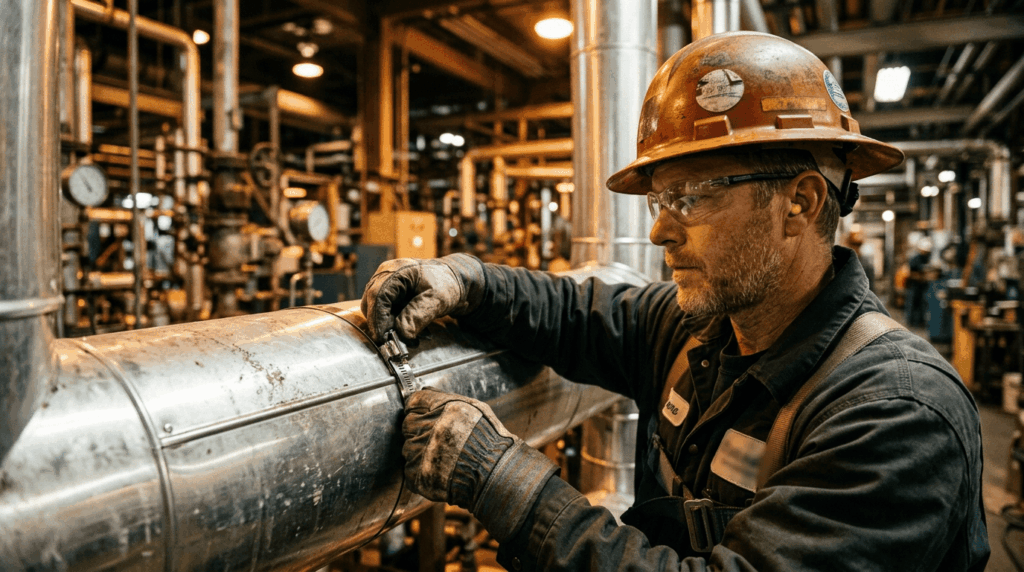
- Loose or missing bands and fasteners
- Gaps in jacketing around valves or flanges
Any small damage to jacketing can allow moisture or contamination to reach the insulation beneath.
Sagging, Compression, or Gaps
Insulation works by trapping air. Compression or distortion damages its effectiveness. Look for sagging, gaps, and areas of compression. Check for unexpectedly warm surfaces — these can indicate missing, wet, or thinned insulation in that area.
How Do You Repair Industrial Insulation?
Address problems as soon as they are identified to prevent them from worsening. The repair should match the specific problem.
Sealing and Patching Jacketing
For minor damage, cleaning the area and applying a sealant or patch may be sufficient. Replace the entire section of jacketing if the damage is larger. Ensure all seams are properly sealed and overlaps channel water away from the insulation.
Replacing Wet or Damaged Insulation
Wet insulation is usually irrecoverable. If insulation is saturated, compressed, or decaying, it should be removed and replaced. Check the integrity of the pipe or equipment surface before installing the new insulation.
Resecuring Loose Components
Replace or resecure loose fasteners and hardware. Valves and fitting joints should be sealed as they are typically the primary areas of concern.
Keep records for each repair, including the location. A maintenance log allows for tracking persistent issues and planning future maintenance needs.
Best Practices for Extending Insulation Life
- Minimise moisture as your main priority. Quickly repair issues that allow leakage or moisture to contact the insulation.
- Shield high-risk areas. Use removable insulation covers on valves and fittings that require frequent inspection or maintenance.
- Train your team. Ensure workers in insulation areas know the correct removal and replacement procedures.
- Use the right materials. Use insulation materials appropriate for the location and expected service temperatures. This gives the insulation the longest possible service life.
A regular, consistent schedule is typically far less expensive than emergency repairs and costly downtime.
Protect Your Insulation, Protect Your Operations
The benefits of industrial insulation — lower energy costs, greater safety, and improved reliability — will be lost if insulation is neglected. Industrial insulation should be treated as an active, working component of your facility.
Regular visual inspections make a huge impact. Record notes on insulation condition during your rounds, pay close attention to jacket breaches and damaged sections, make corrections as needed, and continue to document. This adds years to your insulation and protects the systems it covers.
For high-impact or high-risk systems, a professional insulation condition survey may be beneficial to catch issues that a visual inspection alone would miss.
Frequently Asked Questions
What Is the Service Life of Industrial Insulation?
Quality industrial insulation can last 10 to 20 years when properly maintained. The greatest factors impacting service life are the ambient environment, moisture exposure, and how quickly damage is repaired. Insulation in high-moisture or high-vibration environments that is neglected will have a significantly reduced service life.
What Is Corrosion Under Insulation (CUI)?
CUI is the corrosion of metal when moisture becomes trapped under insulation. It is a serious concern for metal piping in industrial environments because it is almost always out of sight and very difficult to detect — usually only discovered when a significant failure has already occurred.
Can You Fix Wet Insulation, or Is It a Lost Cause?
Wet insulation almost always has to be replaced. Once insulation absorbs moisture, it traps water against the metal pipe and accelerates corrosion. Drying it out rarely restores adequate performance. Replacement is the correct approach.
What Tools Do You Need to Inspect Insulation?
A basic inspection requires a flashlight, infrared thermometer, and moisture meter. For larger areas or critical systems, an infrared thermography camera is the best option — it can quickly scan large areas and identify wet spots or thermal anomalies without removing jacketing.
What Are the Common Signs of Insulation Losing Efficiency?
Increased utility costs, insulated surfaces that are warmer or colder than expected, visible condensation, and uneven temperature along a pipe run are all signs of performance degradation. An infrared inspection is the fastest and most effective way to confirm where insulation is losing efficiency.
📞 +92-21-34529722
✉ [email protected]
🌐 www.pakinsulation.com