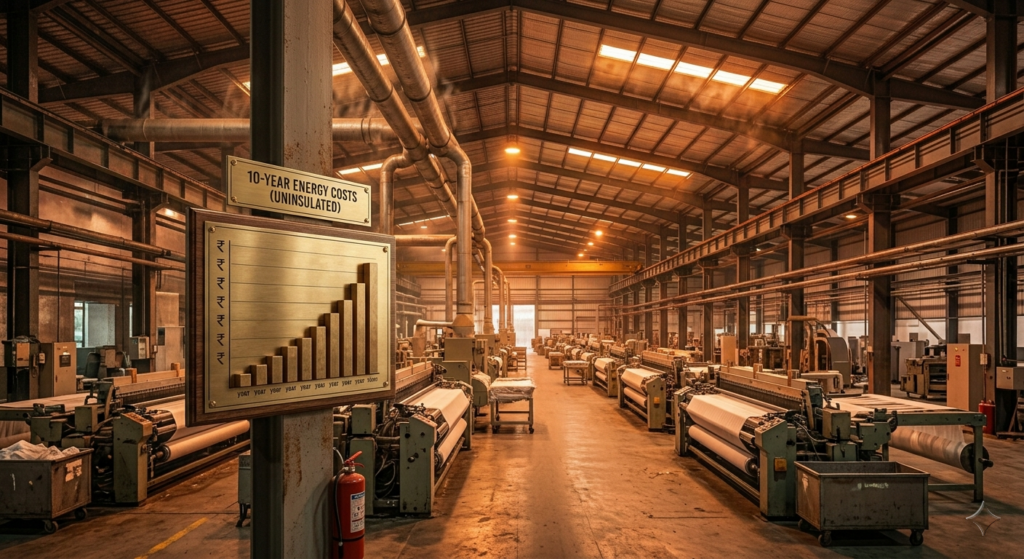
When a factory owner chooses to forego insulation, the language is usually about saving money. The insulation budget gets cut . The building goes up without it and the project comes in under budget . What isn’t calculated is what happens in the next 10 years.
Omitting insulation doesn’t save a cost. It turns a one-off capital cost into an ongoing operating expense and that operating expense builds up every single year, with every single increase in electricity tariff, with every HVAC failure, and with every summer that gets hotter than the last.
The 10-Year Cost Model
Take a medium sized factory in Pakistan, 30,000 sq ft, metal roof, running production 6 days a week with evaporative cooling and spot air conditioning. The realistic electricity bill for this facility is Rs. 1 million per month in peak summer and Rs. 600,000 in cooler months averaging about Rs. 800,000 a month or Rs. 9.6 million a year.
Of that, 30 to 40 percent is directly attributable to the cooling load created by an uninsulated roof and walls. That’s Rs. 240,000 to Rs. 320,000 a month – Rs. 3 to 4 million a year, being used to make up for a building that loses temperature as quickly as the cooling system creates it.
Even with a conservative growth of 8 percent per year in electricity tariffs, the cost of uninsulated cooling compounds to over Rs. 40 million over 10 years. The insulation that could have prevented it would have cost Rs 3 to 3.5 million to install.
| Cost Category | Without Insulation (10 yrs) | With Insulation (10 yrs) | Difference |
| Electricity (cooling load) | Rs. 120,000,000 | Rs. 80,000,000 | Rs. 40,000,000 saved |
| HVAC maintenance & repairs | Rs. 8,000,000 | Rs. 4,000,000 | Rs. 4,000,000 saved |
| Insulation installation cost | Rs. 0 | Rs. 3,500,000 | Rs. 3,500,000 spent |
| Net 10-Year Saving | — | — | Rs. 40,500,000 |
| The factory owner who saved Rs. 3.5 million to avoid insulation invested Rs. 40 million more in the next decade. That ‘saving’ cost them more than 11 times what they saved. |
The Costs That Don’t Show Up on the Electricity Bill
The most obvious cost of under-insulation is energy, but not all the costs are energy costs.
- HVAC and equipment wear: Cooling systems wear out faster with peak load operation 6 months of the year. 4 to 5 years, compressors, fans and evaporative cooling pads that should last 8 to 10 years need replacing. Such unplanned maintenance and early replacement costs add Rs. 3 to 5 million per medium size facility over a decade.
- Worker productivity:It’s not a productive environment on a factory floor in July at 38°C. Output per worker falls sharply above 30°C. Error rates increase. Absenteeism goes up. They don’t appear on any invoice, but they’re real and they add up every summer.
- Export compliance risk: Mills providing European and North American customers are under growing focus over working conditions. A factory that can’t prove temperature-controlled working conditions is a compliance liability, and losing a big buyer contract is a cost way more than any insulation budget.
Why Factory Owners Skip Insulation Anyway
The decision not to insulate is made almost always in the project planning stage, when the capital budget is tight and operating costs are theoretical. The Rs 3.5 million for the insulation line item is real and it is immediate. Rs. 40 million future electricity cost is abstract and stretched over a decade.
This isn’t a financial calculation, but a predictable psychological bias. Now, insulation is expensive, and the owner of the factory is not wrong. They’re wrong, skipping it saves money overall. Insulation is a way of converting a future operating cost into a present capital cost, and one at roughly the ratio of 11 to 1 in the factory owner’s favour.
The Right Way to Think About Insulation Investment
Insulation isn’t an expense. It is a financial instrument that guarantees a predictable return (lower electricity bills) starting from the first month of installation. For a factory of 30,000 sq ft the return is Rs. 300,000-400,000 a month. The Rs. 3.5 million initial investment pays back in less than 12 months and continues to generate that return for the 20+ year life of the insulation.
There are very few capital investments available to a Pakistani factory owner that have a payback period of 12 months and continue to provide return for 20 years with zero ongoing cost. One of those is insulation. Factory owners who get this don’t ask whether to insulate, they ask how fast can they get it done.
Want to know what insulation saves your specific facility?
Pakistan Insulations produces supplying and installing insulation locally with Rockwool insulation for Pakistani factories, warehouses and industrial facilities since 1986. Using your building size, location and cooling load we can provide free energy savings estimate.
Get in touch for a free consultation: