Sandwich Panel Insulation for Pakistan’s PEB Industry: Rockwool vs PUF — How to Get the Specification Right
In the industry of Pre-Engineered Buildings of Pakistan, Rockwool sandwich panels are favored for their fire resistance and sound absorption while PUF (Polyurethane Foam) panels are preferred for their thermal efficiency and are utilized in cold storage. The right specification depends on what your construction will ultimately be used for, fire rating regulations and climatic conditions.
Over the past decade, Pakistan’s building business has seen a significant growth in Pre-Engineered Buildings (PEB). Warehouses, factories, food processing plants and commercial buildings are being developed quicker than ever before and at the core of practically all of them are sandwich panels. When procurement teams and project engineers get down together to specify the insulating core, however, the debate between Rockwool and PUF nearly always arises.
Both are good. Both have passed the test of Pakistani conditions. But picking the wrong one might lead to energy losses, non-compliance with fire codes, or cost overruns that can’t be undone after steel is in the ground. This article will set the basic differences, the cases in which each material wins, and what to look for before you sign off a specification.
What Are Sandwich Panels? Why Does the Core Material Matter?
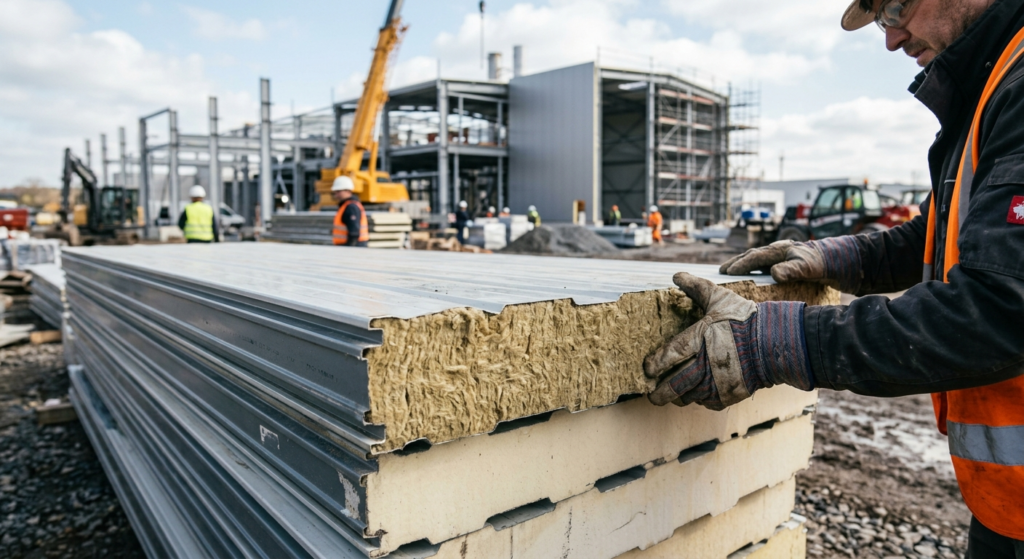
Sandwich panels consist of two metal face sheets, commonly galvanized or color coated steel, bonded to an insulating core. The core affects the heat performance, fire performance, acoustic properties and long term durability. The core material has a direct influence on energy consumption, occupant safety and maintenance costs over the lifecycle of the building in a PEB environment. The panels are the wall and roof envelope.
Wrong specification of core is one of the most common (and expensive) mistakes in Pakistan’s PEB business.
What is the function of Rockwool as a sandwich panel core?
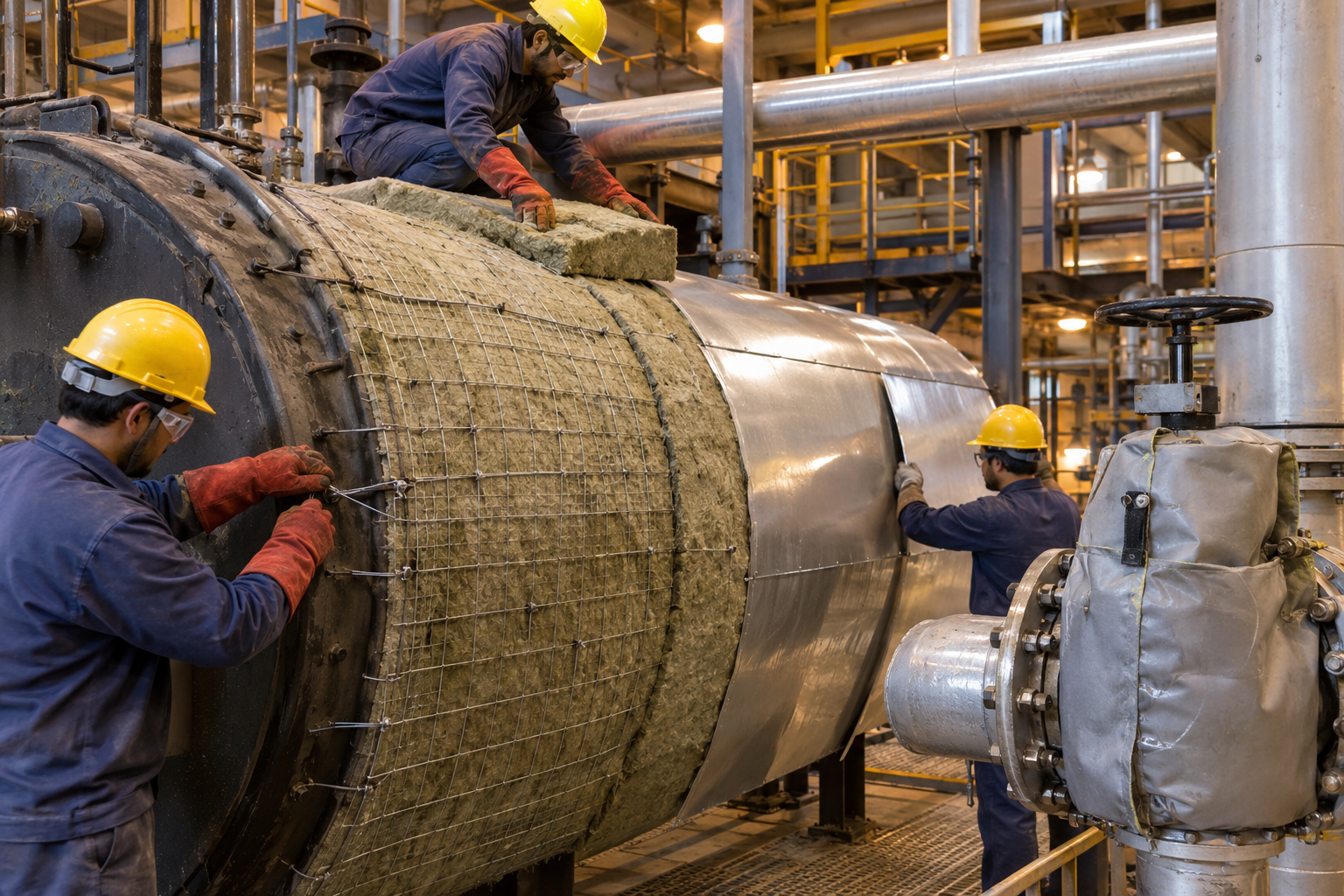
Rock wool (sometimes called mineral wool) is spun from molten rock into dense fibrous carpets. Pakistan Insulations (Pvt.) Ltd. was formed in 1986. The firm makes Rockwool locally under the brand of Termolan. Termolan has been used for major industrial projects throughout Pakistan such as power plants, refineries and pharmaceutical facilities.
Main features of Rockwool panels:
- Fire Resistance: Rockwool is non-combustible and can withstand temperatures of above 1,000°C. This is a big benefit for PEB buildings that include flammable materials, chemicals or high-occupancy spaces.
- Sound insulation: Rockwool is a strong sound absorber because of its fibrous nature. This is a great benefit for factories adjacent to residential areas or with low interior noise levels.
- Thermal performance: Rockwool has strong thermal insulation properties. The lambda (thermal conductivity) is however somewhat higher (about 0.034-0.040 W/m.K) than PUF and consequently thicker panels are needed to reach the same U-values.
- Moisture behavior: Rockwool is not a fertilizer for mold, however it may collect moisture from the air. In humid coastal places like Karachi, precise details and vapour barriers are quite critical.
Use Rockwool panels when: A stringent fire rating is necessary, the building has industrial operations or hazardous materials, acoustic performance is part of the brief, the project must fulfill international fire regulations.
How does PUF work as a sandwich panel core?
Polyurethane Foam (PUF) is a rigid foam injected between the panel facing sheets at production. This is closed cell foam. Founded in 1995, Pakistan Insulations introduced insulation solutions based on PUF, first catering to cold storage and cryogenic applications — a history that indicates precisely where PUF excels.
Key performance features of PUF panels:
- Thermal efficiency: PUF has a lambda value of about 0.022-0.026 W/m.K, which makes it one of the most thermally efficient core materials available. Other insulation materials require thicker panels to get the same U-value.
- Cold chain applications: PUF is the industry standard for cold rooms, cold storage facilities and food processing environments that demand exact temperature control.
- Rigid construction: Closed cell structure gives great compressive strength and dimensional stability of PUF panels under load.
- Fire behavior: The typical PUF is combustible. There are fire-retardant grades available but they are nowhere like the non-combustibility criteria of Rockwool. This is the most significant limitation of the material in industrial PEB applications.
- Weight: The weight of PUF panels is lower than that of Rockwool panels, which reduces the steel tonnage and foundation loads.
Choose PUF Panels when: the main driver is thermal performance, the building is a cold storage or food processing plant, fire loads are low, and project economics support thinner panel profiles.
What are the key specifications decisions for PEB projects in Pakistan?
Getting the specification right is matching material attributes to project specific requirements. Things to consider before you commit to a core material:
What fire rating is required for the project?
This is the first question you will be asked and the answer will often make or break your case. Rockwool is utilized in projects covered by NFPA, British Standards or local building standards for non-combustible envelope materials. The same applies to facilities storing or handling flammable goods, fuel or chemicals.
What is the major heat load on the building?
The climate of Pakistan is variable. Karachi’s humid coastal environment poses a different kind of thermal problem than the dry heat of Punjab or the freezing winters of KPK. PUF is very heat resistant, which means cheaper energy costs for air-conditioned industrial or commercial establishments in hot locations. First calculate your target U value. Then work out the most practical panel thickness to get you there, then figure out what material will get you there.
Does the project cover food, medication or cold chain?
The proper specification is typically always PUF if the response is true. The PUF panels are popular in Pakistan’s cold chain industry because they can preserve tight temperature tolerances while keeping the weight and cost of the panels under control. Pakistan Insulations has been providing PUF based solutions for insulating Cold Rooms, Cold Boxes for Fishing Boats and Cryogenic Applications since 1995.
What is the long-term preservation environment?
Panels for tough industrial locations such as chemical plants, refineries and coastal zones need robust face sheet coatings and cores that resist deteriorating. Both materials can perform well with adequate detailing but the inorganic nature of Rockwool means that it is innately more resistant to long term chemical exposure.
How to find out the thickness of sandwich panels?
Thickness is not uniform, it is a calculation product. The technique is as follows:
- Establish the target U value based on HVAC design parameters or energy efficiency goals.
- Select the core material on fire, acoustic and application criteria.
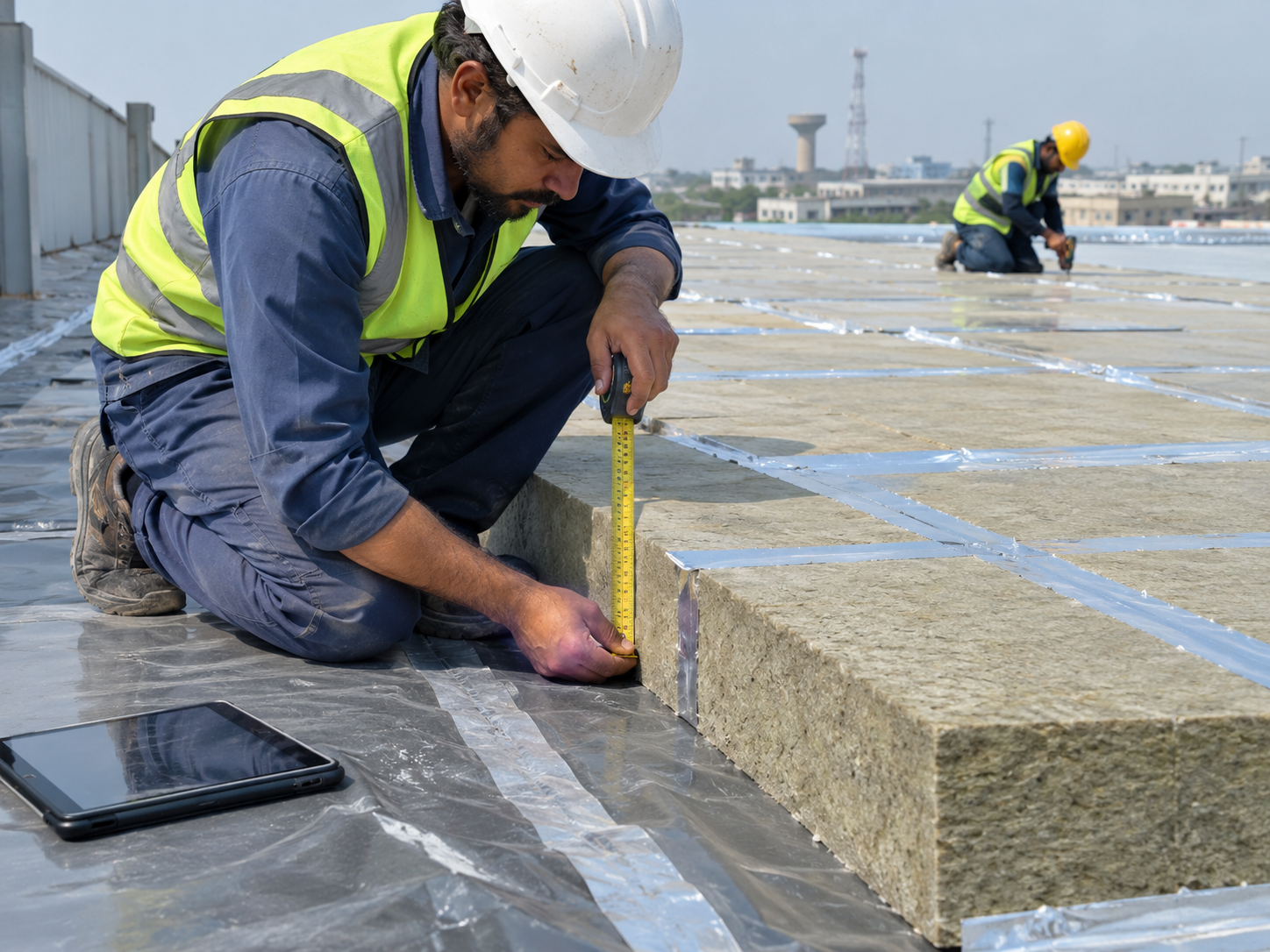
- Calculate the required core thickness to achieve your desired U-value using the lambda value of the material.
- Check for structural adequacy for wind loads, snow loads (if required) and panel span.
One of the common specification errors in Pakistan’s PEB sector is to select panel thickness only on cost basis without completing U-value calculations. The outcome is often a poorly insulated building that consumes significantly more energy than the original HVAC design predicted.
Rockwool vs PUF: Comparison
| Property | Rockwool | PUF |
|---|---|---|
| Thermal conductivity (W/mK) | 0.034–0.040 | 0.022–0.026 |
| Fireproof | Non combustible | Combustible, FR Grades available |
| Acoustic performance | Great | Limited |
| Typical Uses | Commercial, fire rated, industrial | Cold storage, food processing, general warehousing |
| Panel mass | Heavier | Lighter |
| Moisture sensitivity | Moderate (requires vapor barrier) | Low (closed cell structure) |
Getting the Right Advice Before Specification
The specification of sandwich panels is a project specific choice. There is no one answer to all PEB constructions in Pakistan. End use, fire compliance, climatic zone and budget all interact in ways that make generic suggestions unreliable.
Since 1986, Pakistan Insulations (Pvt.) Ltd. has been serving the industrial and construction sectors of Pakistan with Rockwool and PUF solutions for power plants, refineries, cold storage facilities and commercial buildings. If your team is reviewing a PEB specification and needs assistance deciding which insulation system is right for your project, the best way to avoid costly specification mistakes is to get a professional opinion early – before procurement.
For project requirements, please contact Pakistan Insulations at [email protected] or +92-21-34529722.
Frequently Asked Questions
Rockwool vs PUF Sandwich Panels in PEB industry of Pakistan
Rockwool sandwich panels contain a non-combustible mineral wool core, which is acoustically effective and suitable for use in fire approved industrial applications. PUF Sandwich Panel offers good thermal efficiency with durable polyurethane foam core, the normal option for cold storage and food processing facilities. The appropriate approach depends on the building’s ultimate purpose and fire compliance regulations.
Can PUF panels be used to fulfill fire safety standards for industrial PEB structures in Pakistan?
Standard PUF is combustible and does not meet the non-combustibility criteria as specified in codes such as NFPA or BS standards. Fire-retardant PUF grades slow the spread of flames but do not provide the non-combustible certification that Rockwool provides. Rockwool is the norm for industrial structures with a high fire risk.
What is the thickness of sandwich panels for PEB warehouse in Pakistan?
Your panel thickness depends on the U-value you are looking for, which depends on your HVAC design and climate zone. A frequent error in energy-efficient design is specifying thicknesses before you know the U-value. These calculations may be done by a skilled insulation professional based on the thermal demands of your project.
Manufactured Rockwool in Pakistan?
Yes. Pakistan Insulations (Pvt.) Ltd., has been manufacturing Rockwool locally since 1986 and is among the few locally produced mineral wool insulation solutions available in Pakistan under the Termolan brand.
Which is the Best Insulation Material for Cold Storage Facilities in Pakistan?
PUF (Polyurethane Foam) is the market standard for cold storage applications. Its closed-cell design, low thermal conductivity and dimensional stability make it excellent for maintaining exact temperature ranges in cold rooms, food processing facilities and cryogenic applications.
Contact us for a panel specification and supply quote:
📞 +92-21-34529722
✉ [email protected]
🌐 www.pakinsulation.com