How thermal insulation helps Pakistani factories and buildings save money on energy
If your industrial or business facility in Pakistan is operating heavy air conditioning from April through October, chances are a big percentage of your power cost is flowing right out through the roof, walls, and pipes – not into chilling your area.
That isn’t a crazy thing to say. It’s fundamental physics of buildings, and most business owners only learn this after they’ve spent years spending too much for energy.
This is fixed by thermal insulation. Not just a little bit, but a lot. By getting the insulation correct, businesses all around Pakistan, from petrochemical factories in Karachi to cold storage facilities in Punjab, have lowered their energy use by 25 to 45 percent.
This essay goes into detail on how it works, where the largest savings are, and what it looks like in real life.
Pakistan’s Energy Problem Is a Building Problem
Over the past few years, the cost of electricity for businesses in Pakistan has gone up a lot. Businesses and factories in the area now pay some of the highest rates, and for activities that use a lot of energy, including cold storage, manufacturing, and big offices, the bills are hard to handle.
A lot of HVAC and cooling energy is lost because the building envelopes aren’t good enough. Most people don’t know this.
Your chillers and air conditioners have to work harder when heat can easily get in through an uninsulated roof or wall. They’re not cooling your building; they’re fighting it.
In the summer, the surface temperatures on a metal roof of a typical uninsulated industrial shed in Pakistan can get beyond 70°C. That one surface’s radiant heat load can raise a monthly electricity bill by thousands of rupees.
How Thermal Insulation Works in Real Life
There are three ways that heat moves: conduction (through solid objects), convection (through air movement), and radiation (via electromagnetic waves).
Insulation slows down all three by trapping air in its structure, reflecting radiant heat, and making it so that less heat can pass through the surface.
Rockwool (stone wool) insulation is great for Pakistan’s environment since it doesn’t break down in high temperatures, doesn’t absorb moisture, and keeps its thermal effectiveness for decades.
A Rockwool blanket that is put on an industrial roof the right way may cut the amount of heat that gets into a structure by more than 60%. That means your cooling system has to do 60% less effort and uses 60% less power to get the same outcome.
You could hear the term “thermal conductivity” (lambda value) as a technical term. The lower it is, the better it keeps heat in.
Rockwool usually has a thermal conductivity of 0.033 to 0.040 W/mK, which is far lower than that of steel, concrete, or brick that isn’t insulated, which can be 20 to 50 times more conductive.
Expected Energy Savings by Type of Building
| Building Type | Potential Energy Saving | Payback Period |
|---|---|---|
| Factory / Industrial Facility | 25% – 45% | 1.5 – 3 years |
| Commercial Office Building | 20% – 35% | 2 – 4 years |
| Cold Storage / Food Facility | 30% – 55% | 1 – 2 years |
| Power Plant / Refinery Pipework | 15% – 30% | 2 – 5 years |
| Pre-Engineered Steel Building | 20% – 40% | 1.5 – 3 years |
These stats aren’t made up; they’re real. They show what happens when you stop battling your building and allow the insulation do the work that your HVAC system was never meant to do alone.
Where the Biggest Savings Actually Come From
1. Roofs and Ceilings
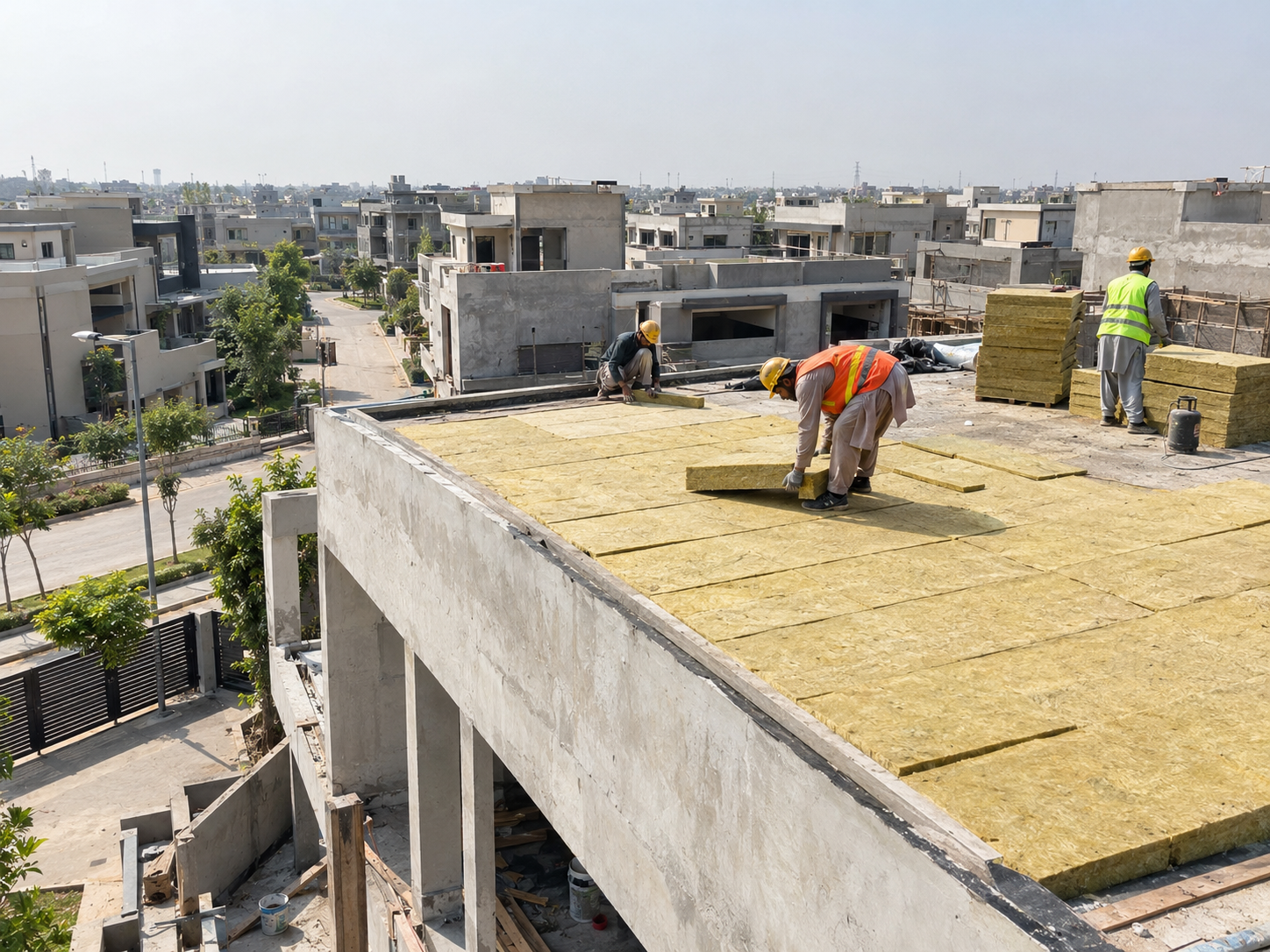
The roof is the part of a building that gets the most heat in Pakistan’s weather. A roof made of bare metal or concrete collects sunlight all day and sends it back inside until late at night.
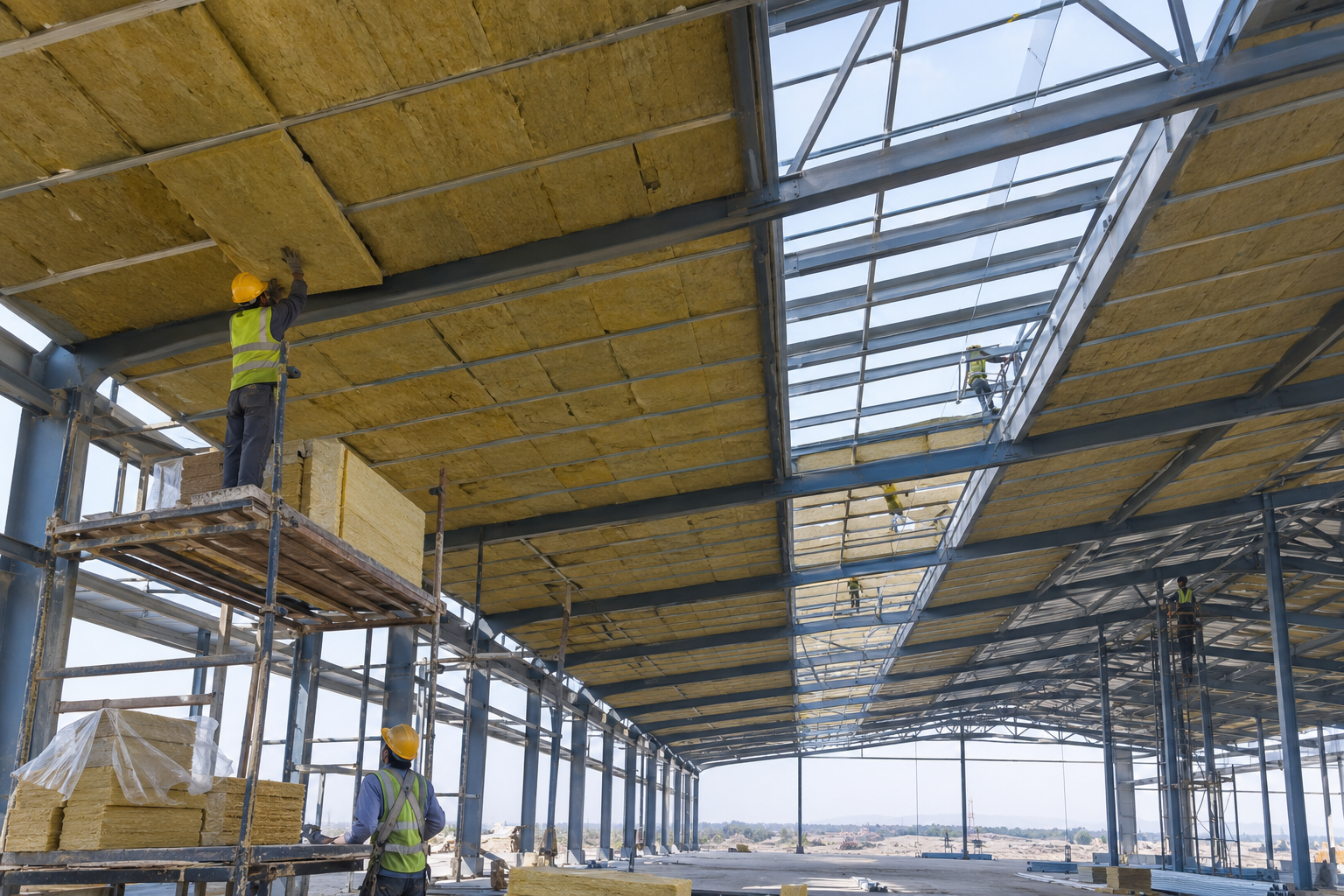
The best thing you can do to save money is to insulate the roof using Rockwool blankets, sandwich panels, or rigid boards.
In Pakistan’s industrial sector, pre-engineered steel buildings (PEBs) are becoming popular.
A factory with a 10,000 square foot roof may save Rs. 80,000 to Rs. 200,000 on power bills each month, depending on how many people are there and how much cooling is needed.
In most cases, the insulation pays for itself in two to three years.
2. Facades and Walls
ones don’t let in as much heat as roofs do, but they do important, especially ones that face west and get intense sunlight in the afternoon.
Rockwool stiff boards or sandwich panel cladding on outside walls keep heat from getting in and noise from getting out, which is a plus in factories.
3. Pipes and Equipment Insulation
People don’t pay much attention to this in buildings, but it’s a big problem in factories.
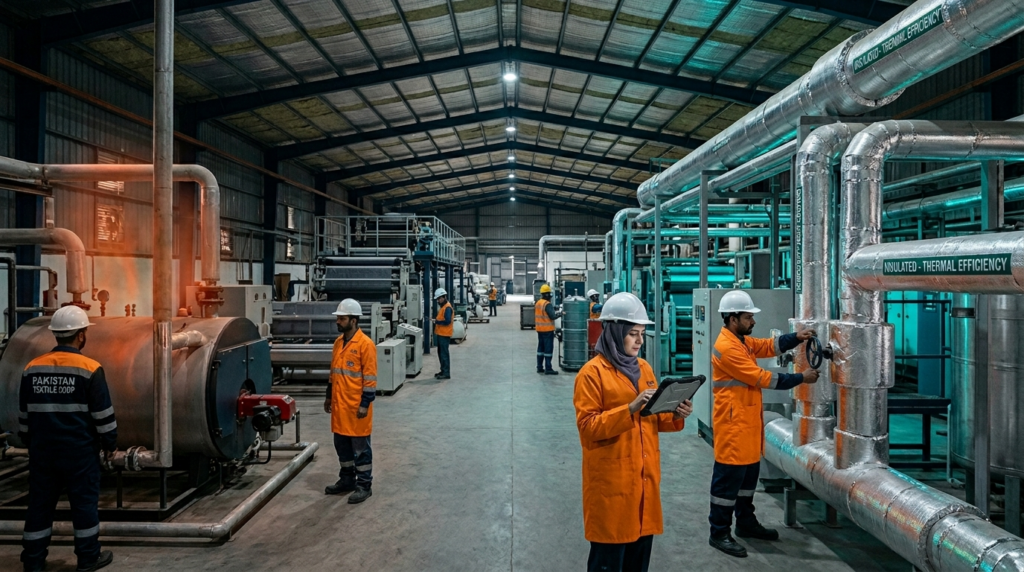
Hot pipes in a refinery or power plant that aren’t insulated lose heat all the time. Cold pipes that aren’t insulated in a food plant cause condensation, humidity difficulties, and energy loss all at the same time.
Clients in Pakistan’s petrochemical and power sectors, such the PARCO mid-country refinery and Rousch Power’s facility at Khanewal, employ pipe insulation to keep process temperatures stable and stop heat loss that would otherwise need additional fuel or energy upstream.
The savings here are more than simply for comfort.
4. Food and cold storage facilities
Bad insulation costs the most in cold storage.
Every degree of temperature difference implies your refrigerated compressors are operating harder.
Polyurethane foam insulation is the best choice for cryogenic and home cold rooms. It keeps the cold in and the heat out with a lot less work from the compressor.
A well-insulated cold room can minimize refrigeration energy usage by 30 to 55 percent compared to a poorly insulated one.
For businesses who keep their refrigerators running 24/7, there’s a big drop in fixed costs month after month.
The ROI Calculation That Most Companies Don’t Do
Many company owners don’t insulate their buildings well because they only think about the expense of installation up front.
What does it cost not to insulate is the better question.
If your facility uses Rs. 500,000 per month on power and insulation can realistically lower that by 30%, you’re saving Rs. 150,000 each month — Rs. 1.8 million per year.
Installing all of Rockwool in a medium-sized factory could cost between Rs. 3 and 5 million. That’s a payback period of less than three years, and you’ll keep saving for 15 to 20 years after that.
The math changes in your favor quickly.
And it doesn’t become worse with time, unlike other equipment. Insulation doesn’t lose value over time.
Rockwool that is put in today will work almost exactly the same way ten years from now.
There’s also the equipment angle.
Your chillers and HVAC equipment last longer when they don’t have to work as hard. Even if you never include them in the initial ROI calculation, lower maintenance costs and longer equipment lifespans make the financial argument stronger.
Who Should Be Talking About This Right Now
- A factory or warehouse with uninsulated metal roofs is almost probably losing a lot of energy every month.
- Cold storage or food processing facility: the insulation specification directly affects how much energy is used for refrigeration.
- A pre-engineered structure with no insulation within. Sandwich panels or Rockwool blankets are common for a reason.
- Whether it’s a refinery, power plant, or petrochemical complex, insulating pipes and equipment is a must, not a choice.
- A commercial office building with escalating HVAC costs—insulating the walls and roof may make a big difference in comfort and expenses.
- Clean rooms for making food or drugs—it’s hard to keep the right temperature without good insulation at a reasonable cost.
How Good Insulation Works in Real Life
People often think that all insulation is very much the same and that the only thing that matters is how thick it is. No, it isn’t.
Choosing the correct materials, doing a good job of installing them, and making sure they are the right fit for the job are all important.
Rockwool can withstand temperatures up to 1,000°C, doesn’t soak up water, and keeps its thermal performance for decades.
Polyurethane foam is excellent for storing things in the cold when you require very low lambda values in small places.
Rigid boards are good for flat roofs that need structural support when they are loaded.
If you don’t follow the right specifications—like utilizing the wrong material, not enough thickness, or not installing it correctly—you might lose 50% or more of your savings compared to a well designed solution.
This is when it matters to collaborate with a manufacturer that also does the installation.
You’re not just getting a product; you’re getting a thermal solution.
Want to know how insulation may help your building?
Since 1986, Pakistan Insulations has been developing and putting up thermal insulation for industries, power plants, cold storage facilities, and businesses.
We make Rockwool in Pakistan, which means speedier shipping, assistance from people in Pakistan, and products made to work well in Pakistan’s environment.
Get a free consultation and energy savings estimate for your facility: