Insulation for Cold Storage:
The Secret to Reduced Refrigeration Costs and Food Safety
Pakistan’s cold storage facilities overwork its compressors. It’s not because the refrigeration equipment is small; in most cases, it isn’t. because the compressors are struggling to make up for the building envelope’s continuous temperature loss.
Higher electricity costs are not the only consequence of poor insulation in a cold room. Temperature swings that jeopardize food safety, accelerated compressor wear, humidity issues, condensation on panels, and in extreme situations, structural damage to the cold room itself are all consequences. The insulation is the cornerstone upon which everything else is built; it is not an afterthought.
This article discusses what constitutes appropriate cold storage insulation in Pakistan, what materials are suitable for certain uses, and what is most frequently specified incorrectly on local projects.
The Differences Between Regular Building Insulation and Cold Storage Insulation
Although the insulating principleslowing down heat transfer remain the same, the performance standards and failure penalties differ.
Inadequate insulation makes a typical industrial building uncomfortable and hot, and your HVAC system has to work harder. Inadequate insulation causes the temperature inside a cold room to increase more quickly than the refrigeration equipment can lower it. Once that cycle begins, you are either continuously using the compressor at maximum load or you are tolerating temperature variations that endanger your goods.
Condensation and vapor pressure are two other issues that do not arise in warm-side applications.
Condensation
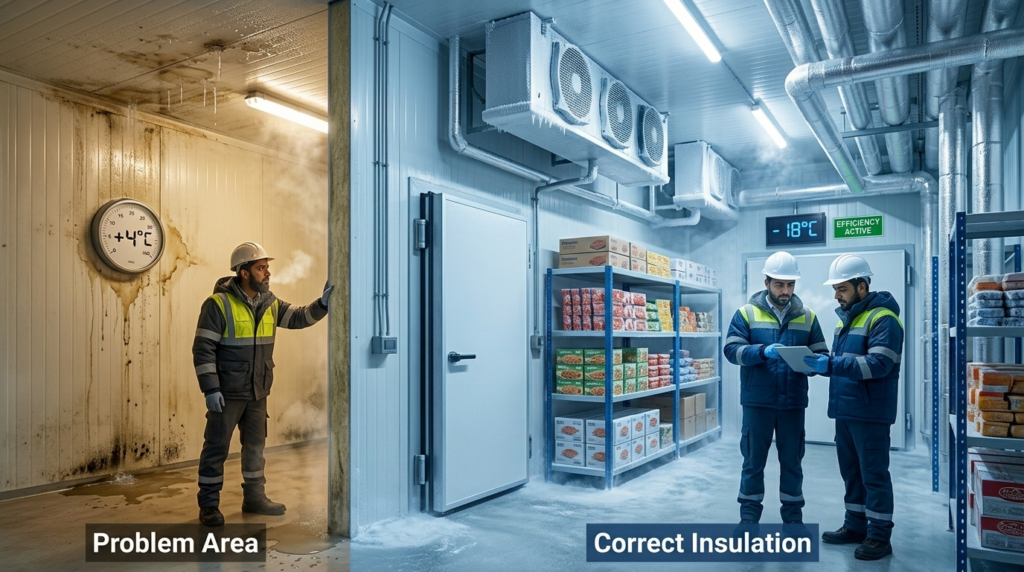
Moisture condenses when warm, humid outdoor air comes into contact with a cold surface. Condensation develops inside the panel structure of a poorly insulated cold room, not on the surface where it would be visible. Over time, this decreases thermal performance, promotes mould, and in severe circumstances leads the panel to delaminate or the supporting structure to corrode.
Closed-cell foam materials having a very low vapour permeability, which prevents warm, humid air from penetrating the panel far enough to reach the cold surface and condense, are used in good cold storage insulation.
Pressure of Vapor
A cold room panel’s warm and cold sides are always under different pressures. Moisture migrates toward the chilly interior as a result of this. Moisture can enter through any joint, puncture, or improperly sealed panel edge. Because of this, sealing is just as important in cold room construction as insulating thickness.
Within two to three years, the thermal performance of a cold room with good panel specifications but inadequate joint sealing will deteriorate due to moisture buildup in the panel edges. The installation has failed, not the insulation.
What Kind of Insulation Is Best for Cold Storage?
PUF, or polyurethane foam, is the industry standard for cold rooms.
For good reason, polyurethane foam is the most used cold storage insulation material in Pakistan and around the world. Because it has the lowest thermal conductivity of any commonly available insulation, usually between 0.022 and 0.028 W/mK, you can obtain the necessary thermal resistance in a thinner panel than with any other option. This is important in cold storage, where interior space is valuable and panel thickness immediately affects usable floor area.
PUF panels are the industry standard for cold room walls, ceilings, and floors. They are made as stiff sandwich panels, with a PUF core sandwiched between two metal skins. They are delivered as completed panels that seal and interlock, reducing the number of joints and possible areas for moisture intrusion.
100mm PUF is usually sufficient for home cold rooms (above 0°C). 150 to 200 mm is standard for blast freezers and cryogenic applications below -18°C. The interior temperature, the ambient temperature differential, and the panel’s thermal conductivity are used to determine the necessary thickness.
Rockwool – Where Fire Resistance Is Required
One major drawback of PUF is that it burns. PUF panels by themselves do not satisfy the requirements in food processing facilities, pharmaceutical cold stores, or any other application where fire resistance is required by law or insurance. As an alternative to fire-rated cold room assemblies, rockwool offers good thermal performance, is non-combustible up to 1,000°C, and, when properly detailed, can manage moisture rather well.
In reality, a lot of industrial cold storage facilities in Pakistan employ a hybrid strategy that uses PUF for the thermal performance of the main panel and Rockwool-based fire-rated assemblies in certain places, such as at the boundaries of fire compartments, near processing equipment, and around electrical panels.
For irregular geometries, use closed-cell spray foam.
Closed-cell spray polyurethane foam is used in-situ when cold rooms are incorporated into pre-existing buildings with complex geometry, piping penetrations, or uneven walls that prefabricated panels cannot neatly accept. It creates a continuous, joint-free vapour barrier by expanding to fill spaces and sticking to any surface. Although it requires more labor and is more difficult to quality-control than panel installation, it is frequently the only feasible choice for retrofit applications.
Specifications for Insulation by Type of Cold Room
| Application | Recommended Material | Key Advantage | Typical Thickness |
|---|---|---|---|
| Cryogenic rooms and blast freezers | PUF (polyurethane foam) | Compact panels with the lowest lambda | 150–200 mm |
| Standard cold rooms (+2°C to +8°C) | Sandwich panels made of PUF | economical and airtight | 100–150 mm |
| Cold storage facilities (+8°C to +15°C) | PUF or Rockwool boards | Panel specification flexibility | 80 – 120mm |
| Access points and doors to cold rooms | PUF door with a fire rating | Thermal + fire integrity per fire rating | Per fire rating |
| Pipe & equipment insulation | Rockwool with closed-cell foam | with condensation management based on heat gain calculations | Per heat gain calc |
Pakistan’s Cold Storage Initiatives Make a mistake
Panel Thickness Underspecification
Specifying panel thickness based on upfront cost instead of thermal calculation is the most frequent mistake. Compared to a 100mm panel, a 75mm PUF panel is less expensive. However, the 75mm panel will cost more in electricity and compressor maintenance within 18 months than the difference in panel cost if the thermal calculation for the ambient conditions in Karachi or Lahore calls for 100mm to maintain the necessary interior temperature without overtaxing the refrigeration system.
Inadequate Penetration and Joint Sealing
Prefabricated cold room panels interlock, however in order to provide a continuous vapour barrier, the joints need to be sealed with the appropriate tape or sealant. Common moisture entry locations are pipe penetrations through panels for electrical, drainage, and refrigerant lines. On poorly executed installations, these penetrations are filled with general-purpose silicone rather than closed-cell foam backer rod and cold-room-grade sealant. As a result, the panel gradually deteriorates due to moisture ingress, which is invisible for months.
Absence of Floor Insulation
A large percentage of cold storage projects in Pakistan lack floor insulation. The justification is typically expensive and complexity; in order to adequately insulate a floor, the floor level must be raised, which has an impact on door thresholds, racking heights, and access. However, heat from the ground is constantly conducted by an uninsulated cold room floor, especially during the summer when ground temperatures are high. If you want the refrigeration system to function within its intended boundaries in rooms below +5°C, floor insulation is a must.
Incorrect Door Specification
The weakest thermal link in the entire system is frequently found in cold room doors. Every time a poorly sealed door is opened, a well-insulated room loses temperature; if the seals are worn or the door isn’t hanging properly, this loss occurs continuously when the door is closed. Cold room doors must have replaceable seal systems, efficient cam-action closing mechanisms, and the same thermal rigor as the panels.
The cumulative energy cost of a single poorly sealed cold room door can exceed Rs. 50,000 to 80,000 per year in additional compressor load for facilities that run refrigeration around-the-clock. This is frequently more than the cost of replacing the door seals or upgrading the door completely.
The Benefits of Proper Insulation for Energy Savings
Continuous cold storage refrigeration is used. There is no off-peak time when the system isn’t operating, unlike HVAC in an office building. Every watt of heat that enters via a poorly insulated panel, every degree of temperature variation the compressor must regulate, and every day of the year, all of these factors immediately translate into electricity use.
When compared to a poorly insulated equivalent, a properly insulated cold storage facility with the right panel thickness, sealed joints, insulated floor, and door specifications can cut refrigeration energy consumption by 30 to 55 percent. The difference in electricity expenses alone for a medium-sized cold storage enterprise using a 50kW refrigeration system at PKR 50 per kWh is between Rs. 300,000 and 600,000 annually.
Unlike a compressor, the insulation does not deteriorate. For 20 to 25 years, a properly placed PUF panel in good condition will continue to function thermally. The benefits of correctly completing the specification are measured in months rather than years.
Questions to Consider Before Choosing Cold Storage Insulation
- What range of internal temperatures is necessary? This establishes the thickness of the panel. The needs of a -25°C blast freezer and a +5°C chilled room are essentially different.
- What is the site’s average temperature and humidity? In the coastal climate of Karachi, a cold room experiences higher humidity loads than one in Lahore. Sealing requirements and panel specifications are different.
- Is it necessary to be fire resistant? Instead of using standard PUF panels, food processing, pharmaceutical, and any facility with regulatory fire requirements may require Rockwool or fire-rated PUF assemblies.
- How is the floor doing? New construction allows proper floor insulation from the slab up. Retrofit projects require a different approach. Clarify this before the panel spec is finalised.
- Who is doing the installation? Panel quality is meaningless if the installation joint sealing, penetration detailing, door hanging is poor. The installer matters as much as the material.
Building or upgrading a cold storage facility in Pakistan?
Pakistan Insulations supplies PUF sandwich panels, Rockwool insulation systems, and fire-rated cold room doors for cold storage facilities across Pakistan. We manufacture locally, which means faster delivery, on-site support, and specifications designed for Pakistan’s climate conditions.
Get a panel specification and energy savings estimate for your project: