Construction Safety in Pakistan: What Fire-Rated Doors Actually Do
The majority of people have incorrect ideas regarding fire doors. They view them as obstacles that slow down the spread of fire. That is a part of it, but compartmentalization keeping a fire contained to the area where it originated long enough for people to flee, emergency personnel to arrive, and the damage to be restricted to a portion of a building rather than the entire structure is the more crucial role.
Only a small percentage of buildings in Pakistan’s construction industry have fire-rated doors installed. A portion of this is awareness; many customers and even contractors are unaware of the significance of fire ratings, the situations in which they are necessary, or the repercussions of using the incorrect door. All of it is directly addressed in this post.
What a Fire-Rated Door Really Does
A typical door, even one made of solid steel, will collapse in a fire in a matter of minutes. The gaps are the cause, not just the door itself. Air leaks through the keyhole, beneath the door, and around the door frame. Not only does fire travel through solid materials, but it also travels through smoke and heat in any opening. Regardless of the material of the door panels, evacuation becomes hazardous or impossible once smoke fills a corridor.
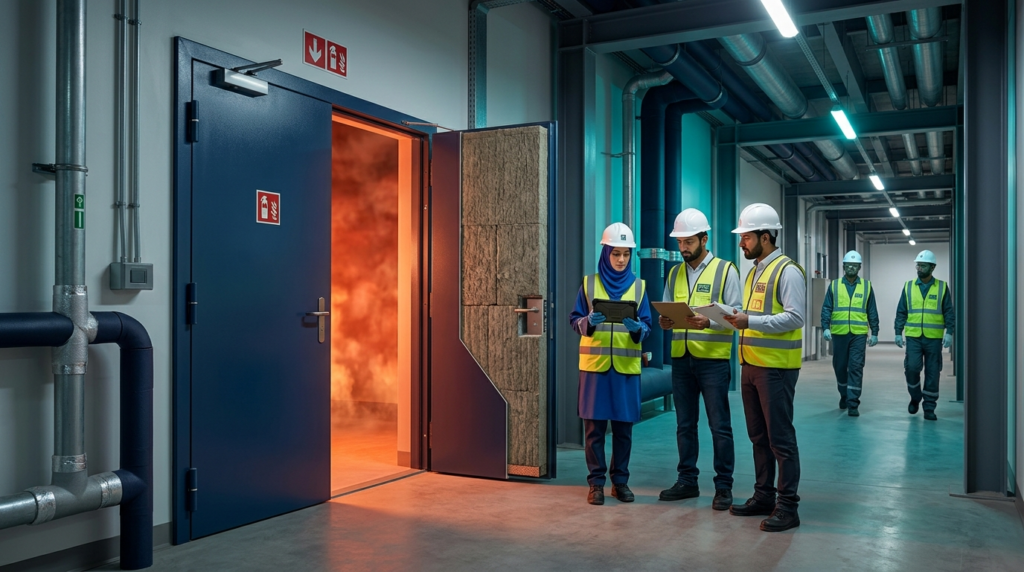
A fire-rated door is designed as a whole system. Together, the hardware, seals, door leaf, and frame are tested. When exposed to heat, the intumescent seals around the door edges expand, sealing the holes that would otherwise let flames and smoke flow through. In order to stop heat transfer through the panel, the door itself is filled with fire-resistant material, usually a Rockwool core.
Three things are measured by the test standard: smoke control, insulation (the surface temperature on the protected side stays below a threshold that would ignite items), and integrity (no flames or hot gases through the door). A door is rated FD60 if it passes all three for sixty minutes.
A door that buys time is the end outcome. Thirty minutes can make the difference between a chaotic situation and an orderly escape in a major fire. A complete emergency response takes 60 minutes. The rated time requirements increase in industrial settings with heavy fuel loads, such as chemical factories, warehouses, and refineries.
An Explanation of Fire Door Ratings
The length of time a fire door can contain a fire under typical test conditions determines its classification. The most widely used ratings in Pakistan are in line with European EN 1634 norms and British Standard BS 476:
| Fire Rating | Duration | Typical Application |
|---|---|---|
| FD30 / 30-Minute | 30 minutes | Small offices and low-risk internal hallways |
| FD60 / 60-Minute | 60 minutes | Plant rooms, storage spaces, and stairwells |
| FD90 / 90-Minute | 90 minutes | Escape routes and large commercial buildings |
| FD120 / 2-Hour | 120 minutes | Hospitals, factories, refineries, and high-risk areas |
| FD240+ / 4-Hour | 240+ minutes | Power plants, essential infrastructure, and petrochemical |
The size of the compartment being protected, the occupancy type, the building’s fire risk assessment, and, in some situations, the distance to the closest fire exit all influence the rating you require. FD60 should be regarded as a minimum and FD120 is frequently specified for industrial facilities in Pakistan, especially those in the manufacturing, food processing, and energy industries.
Where Fire-Rated Doors Are Needed
Factories and Industrial Facilities
A fire-rated door is required for any compartment border in a factory where a fire could spread from a high-risk location (such as electrical rooms, boiler rooms, generator rooms, or chemical storage) to a general work area. In multi-story industrial buildings, stairwells and lift shafts must be enclosed with fire doors they are the escape routes, and they must stay useable.
Office and Commercial Structures
Fire doors are necessary in business buildings for escape stairwells, service rooms (IT, mechanical, and electrical), and corridors that act as safe escape routes between commercial units. This is becoming more and more necessary in high-rise and mixed-use developments due to Pakistan’s NFPA-influenced building codes.
Food Facilities and Cold Storage
A particular problem for cold storage facilities is that insulated panels that offer thermal performance could not be fire resistant. Thermal insulation and fire integrity are two needs that are not often satisfied by the same product. For a cold room, a fire-rated door needs to offer both. This calls for doors not simply regular fire doors that are made to address the thermal bridging problem at the frame.
Refineries and Power Plants
This is the point at which insurance needs and regulatory compliance depend heavily on fire door specifications. Control rooms, cable trays, switchgear rooms, and transformer enclosures in power generation and petrochemical facilities need FD120 minimum in many cases FD240 or above. The door specification should never be the least expensive choice because the effects of a fire in these places are so dire.
Hospitals and Healthcare Facilities
Hospitals have patients who cannot self-evacuate. Hospital fire compartmentalization is based on staged evacuation, which involves transferring patients from the fire zone to the next compartment rather than leaving the building right away. Every compartment border must hold, which implies every fire door must perform to its rating.
Pakistan’s healthcare system is growing quickly, and fire door specifications in newly constructed hospitals should receive significantly more consideration than they usually do.
The Problems With Pakistani Fire Door Installations
The effectiveness of a fire door depends on how it is installed. A correctly specified door with poor installation provides basically no fire protection the gaps, the hardware, and the seals have to function together exactly as they were planned and tested.
- Using regular doors instead of fire-rated ones: The most frequent issue. A solid steel door appears similar to a fire rated door but has no intumescent seals, no fire-resistant core, and no tested frame assembly. It gives almost no protection.
- Damage or removal of intumescent seals during installation: Occasionally seals are removed because they cause the door to feel tight or stiff. In the event of a fire, the door collapses instantly without them.
- Inappropriate hardware: Fire door latches, hinges, and door closers need to be rated parts. The fire rating is nullified when normal hardware is installed.
- Wedging fire doors open: Common in busy facilities for ease. A jammed fire door is not a fire door. This is why self-closing systems are in place.
- Incorrect frame installation: The frame is part of the tested assembly. Regardless of the door’s rating, a fire-rated door in a non-rated frame or a frame that is not securely fastened to the wall will fail in a fire.
- No certification or traceability: Test certificates associated with the particular product being delivered should be included with fire doors. Untested or incorrectly certified fire doors are frequently supplied and installed in Pakistan. You don’t know what you really have if you can’t trace the door to a test report.
How Fire Doors Work with Rockwool
The thermal insulation grade of a fire-rated door — or how well it keeps the protected side cool during a fire is determined by the core material inside.
Because it doesn’t burn, melt, or release harmful gases, Rockwool, also known as stone wool, is the typical fire-resistant filler material for high-performance fire doors.
At temperatures as high as 1,000°C, Rockwool retains its structural integrity. Steel starts to lose structural strength at roughly 550°C but a Rockwool-filled steel door will keep the steel below that key barrier for the rated time because the Rockwool absorbs and distributes the heat rather than transmitting it through.
For this reason, it is important to consider the fundamental material specifications rather than just the door’s exterior design. From the outside, a door made of regular mineral wool that isn’t fire-rated will resemble a Rockwool fire door. Only after the building is on fire does the difference become noticeable.
Things to Look for When Choosing Fire Doors for Your Project
- Fire rating: Compare the rating to the size of the compartment, the degree of risk, and the specifications for the evacuation route. Avoid underspecifying in order to save money.
- Test certification: Ask for the test report. It must be traceable to the particular product being delivered and cite an accepted standard (BS 476 Part 22, or EN 1634).
- Complete assembly: The hardware, seals, frame, and door leaf should all be part of the same system that has been tested. Mixing components from multiple vendors invalidates the certification.
- Requirements unique to the application: Thermal bridging control at the frame is necessary for cold storage fire doors. In addition to fire performance, blast-rated or chemical-resistant coatings are frequently required for industrial and petrochemical applications.
- Maintenance plan: Regular inspections of fire doors are necessary. Seals deteriorate. Door closers fail. Hinges get worn. If a fire door is neglected, it may not function as intended.
Do you require fire-rated doors for your establishment?
Pakistan Insulations creates and provides fire-rated doors for power plants, commercial buildings, cold storage, and industrial facilities. Our doors come with complete test certification and employ fire-resistant Rockwool cores. In addition, we provide Rockwool insulation systems for fire-rated wall and roof assemblies and can offer advice on all of your project’s compartmentation needs.
For a specification consultation, get in touch with us: